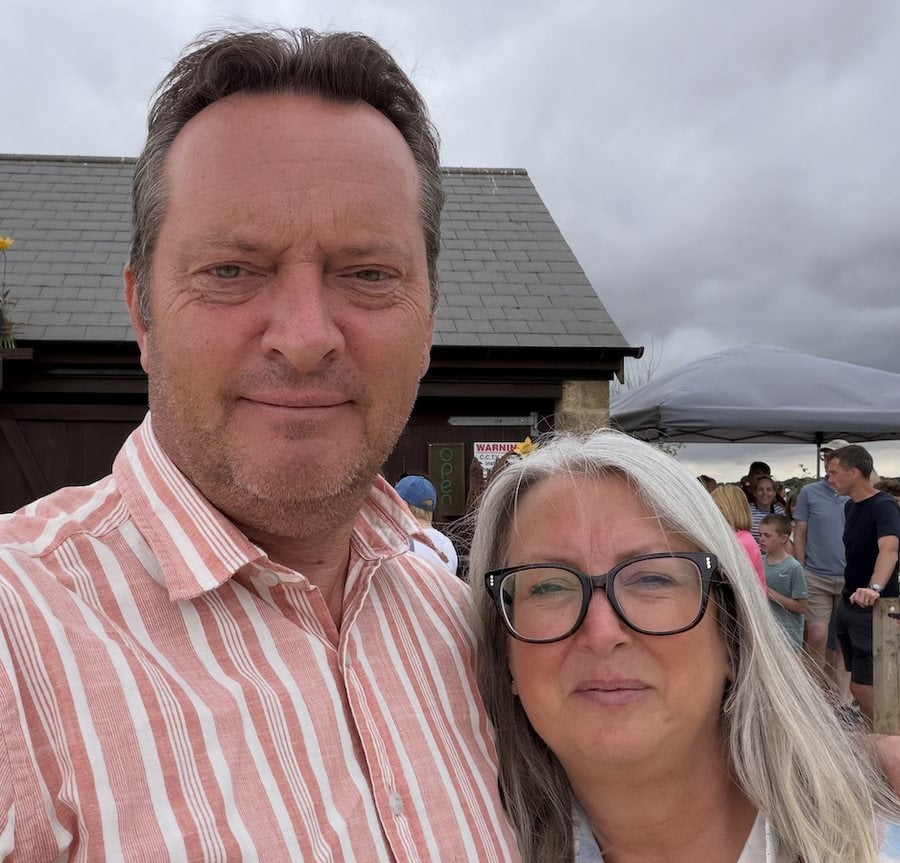
Sarah and David’s story
We didn’t set out to build a bioresonance business.
In fact, when all of this began, neither of us knew very much about bioresonance at all.
We were simply a family in Leeds. We had two children, a family business, holidays to look forward to and all the usual things that fill everyday life.
Then Sarah became ill.
What followed changed our lives, and eventually led us somewhere neither of us could have imagined.
It started with tiredness.
Sarah had always been in generally good health. After our children started school, she returned to the family business. She had been diagnosed with an underactive thyroid and prescribed Levothyroxine, and for a number of years life carried on relatively normally.
Then, towards the end of 2007, things began to change.
Sarah became increasingly tired. Eventually she had to stop working. She was losing weight, and her skin had developed an unusual tan-like colour, despite us not having been abroad.
We went to the doctors, but initially there was no explanation for how dramatically Sarah seemed to be changing.
I could see that something wasn’t right. At home, things were changing too. Sarah was able to do less and less, while I was trying to work, look after the children, cook, clean and keep everything else going.
We didn’t know what was wrong. We just knew this wasn’t normal tiredness.
Then my mum started writing everything down.
Sometimes a seemingly small decision changes everything.
My mum took Sarah to her house and began writing down her symptoms and medical history.
She started researching and came across a book by Dr Gordon Skinner, Diagnosis and Management of Hypothyroidism. In it she found information about Addison’s disease, a rare disorder involving the adrenal glands.
Armed with that information, we went back to our GP. This time, the doctor examined Sarah carefully, including the darker pigmentation in the creases of her hands. He suspected Addison’s disease and arranged for Sarah to be seen urgently.
We didn’t yet appreciate quite how serious things had become.
Finally, we had an answer.
At the hospital, an endocrinologist also suspected it and arranged the appropriate testing. The results confirmed that Sarah’s adrenal function was severely impaired.
She was prescribed Hydrocortisone, Fludrocortisone and Levothyroxine, medication that became an essential part of managing her condition.
There was enormous relief in finally knowing what was wrong.
But getting a diagnosis wasn’t the end of the story. Sarah was alive and receiving the conventional medical treatment she needed, yet everyday life still wasn’t the life we’d known before. She experienced significant physical limitations and struggled with things that had previously been completely ordinary.
We were grateful for the medicine. We also wanted to know whether there was anything else we could explore alongside it.
That distinction has remained important to us ever since.
That’s when bioresonance came back into the conversation.
We’d heard people talk about bioresonance before. Friends had told us about their experiences, but when you’re healthy, it’s very easy to listen politely and then carry on with your life.
I was also sceptical. I had no medical background. Sarah had worked as a pharmacy dispenser, so conventional medicine was what we knew and trusted.
But our circumstances had changed. I began researching. Eventually, we booked Sarah an appointment with a local bioresonance practitioner.
Our first session was nothing like I expected.
It took place in someone’s home. The practitioner was running more than an hour late. Sarah sat in a chair while he worked with a frequency device and tested responses using a biotensor.
I’d never seen anything like it. If I’m truthful, I wasn’t convinced.
The session lasted around 90 minutes. We went home without really knowing what to expect.
But later that evening, we noticed something. Sarah would normally lie on the sofa before bed and struggle when it was time to get up and climb the stairs. That evening seemed different.
It was only one experience. It didn’t prove what had caused the difference. But it was enough to make me curious.
And curiosity is really where the next part of our story began.
I started investigating properly.
At the time, I worked in executive recruitment. Researching companies and asking difficult questions was something I knew how to do. So that’s what I did.
I contacted manufacturers and practitioners around the world. I investigated different devices. I travelled to meet people. I wanted to understand what was behind this therapy we’d stumbled across.
During that period, I also experienced some worrying health symptoms of my own: persistent headaches, neck pain, problems concentrating and an unusual mental and physical lethargy. I’d already seen my doctor and had blood tests, but the symptoms continued.
I eventually went to the same bioresonance practitioner Sarah had seen. He found something he wasn’t prepared to let me walk out with, and told me to go straight back to my GP. I did. Over the following weeks, the symptoms cleared.
I can’t tell you which of those things did it, and neither could he. What I can tell you is that I stopped dismissing bioresonance and started taking it seriously enough to investigate further.
One name kept coming up.
BICOM®.
As I spoke to more practitioners and researched different systems, I kept hearing the same name. Eventually, I contacted the company in Germany.
Before long, I was speaking to its International Sales Director. I explained Sarah’s story, what I’d experienced myself and why I had become interested in the technology.
The response surprised me. He offered to get on a plane and come and see me.
The more I learned about BICOM®, the technology, the practitioner knowledge surrounding it and the support behind it, the more interested I became.
There was just one problem. I had a business. I didn’t want to become a therapist.
I just wanted a BICOM®.
So I became the UK agent.
There’s probably a more impressive origin story I could invent. But the truth is much better.
Becoming the UK agent meant I could get a good discount on a demonstration device. So I did.
I began learning how to use it and working initially with Sarah, family members and friends. People started talking about their experiences. One introduction led to another, and gradually something I’d never intended to turn into a serious business began becoming one.
What mattered most, though, was what was happening at home. BICOM® had become part of the way we supported Sarah alongside the conventional medical care and medication she continued to need.
It wasn’t a replacement for her endocrinologist. It wasn’t a cure for Addison’s disease. And we’ve never wanted to pretend otherwise.
It was another avenue we’d found and chosen to keep exploring.
Then BICOM® became much bigger than our own story.
What started around our family gradually developed into BICOM UK. We began supplying devices, supporting practitioners and developing training.
The practitioner community grew. So did the number of people contacting us because somebody they knew had told them about their experience. And eventually it became too much for me to do everything.
In 2015, Chris joined us and took responsibility for the therapy side of the business. That allowed us to separate two things that had grown naturally alongside each other: helping people experience BICOM®, and helping practitioners learn how to use it themselves.
Those two strands ultimately became the businesses you see today. Reson8 for treatment. BICOM UK for professional devices, training and practitioner support. And Bioresonance.org as the place where we can bring the information, research, practitioner experience and our own story together.
And Sarah?
She’s the reason any of this exists.
Sarah still has Addison’s disease. She still requires her prescribed medication and appropriate medical care. Bioresonance didn’t magically make that disappear.
Over the years, however, BICOM® has remained part of the complementary approach we’ve chosen for Sarah’s wider wellbeing.
And perhaps that’s the most important part of our story. We didn’t discover bioresonance because we rejected conventional medicine. Conventional medicine diagnosed Sarah’s condition and gave her the medication she needed. We discovered bioresonance because, after that, we still wanted to explore what else might help support her.
One led us to the other. And what began as a husband trying to find another way to help his wife eventually became something neither of us planned.
We didn’t start with bioresonance and go looking for a story. We started with Sarah. Bioresonance became part of hers.
Not because Sarah’s experience predicts yours.
It doesn’t. And not because we think everyone should make the same choices we made.
We tell it because it explains why we’re here.
- Why we’re interested in the questions people ask when they feel they haven’t finished exploring.
- Why we care about the difference between making promises and sharing experience.
- Why we use BICOM® ourselves.
- Why we train practitioners rather than simply sell them a device.
- And why, after all these years, this still feels personal.
This is one family’s account. It describes our own experience and the choices we made, and it is not medical advice. Bioresonance is a complementary approach: it is not a substitute for diagnosis or treatment from an appropriately qualified healthcare professional, and we have never used it as one.