
Bioresonance Therapy and BICOM Bioresonance Machines in the UK
HARMONY LIVES WITHIN
MEASURE | BALANCE | THRIVE
What if there is more to understand about the body than conventional approaches alone can reveal?
Bioresonance.org is a place to explore that question.
We bring together research, clinical observations, practitioner experience and real-world case studies from universities, therapists and organisations working with bioresonance around the world.
We’ll introduce the ideas simply, explain how bioresonance is used in practice, share the experiences of practitioners and their clients, and give you access to more detailed research and technical information when you want to explore further.
We don’t see bioresonance as a replacement for conventional medicine. We’re interested in the possibilities it may offer alongside our existing understanding of health, and in bringing together the information, research and experience that can help people make informed decisions for themselves.
The information and personal experiences shared throughout this site are provided for education and discussion and should not replace advice, diagnosis or treatment from an appropriately qualified healthcare professional.
You may have arrived here with a very different question from the person reading this after you. So rather than making everyone follow the same path, start with yours.
Discover what happens during a consultation, what a therapy session involves and meet the team at our Reson8 clinic.
Explore the BICOM® Optima, professional applications, practitioner training and support.
Explore how bioresonance is proposed to work, alongside research, case studies, technical papers and practitioner experience.
The word bioresonance sounds complicated. The principle behind the name is easier to understand.
“Bio” means life. “Resonance” describes what happens when something responds to a particular frequency.
A familiar example is a tuning fork. Strike one tuning fork near another tuned to the same natural frequency and the second can begin to vibrate.
That’s resonance.
Our bodies are, of course, considerably more complex than tuning forks. Living cells and tissues involve electrical and electromagnetic activity. Bioresonance developed from the idea that information associated with this activity could potentially tell us something useful about what is happening within the body.
And that’s where BICOM® comes in.
BICOM® bioresonance uses a specialist device to receive information via applicators, process that information and return modulated signals during a therapy session.
The theory behind exactly what happens can become technical very quickly, and we’ll take you into the biophysics, frequency patterns and research elsewhere on the site.
What a session is like is simpler. It is non-invasive, drug-free and generally involves sitting or lying comfortably while a practitioner works with the BICOM® device and its applicators.
For people completely new to bioresonance, that’s enough to get started.
- Non-invasive and drug-free
- You sit or lie comfortably
- The practitioner works with the BICOM® device and its applicators
- Applicators may touch the skin or sit over clothing
- No needles
People who explore complementary approaches may describe digestive discomfort, skin issues, tiredness, sensitivities, respiratory symptoms or other concerns that have led them to look more closely at their health.
Bioresonance practitioners approach this from a different perspective. Rather than looking only at the symptom, the aim is to consider the individual and the different stresses that may be affecting them.
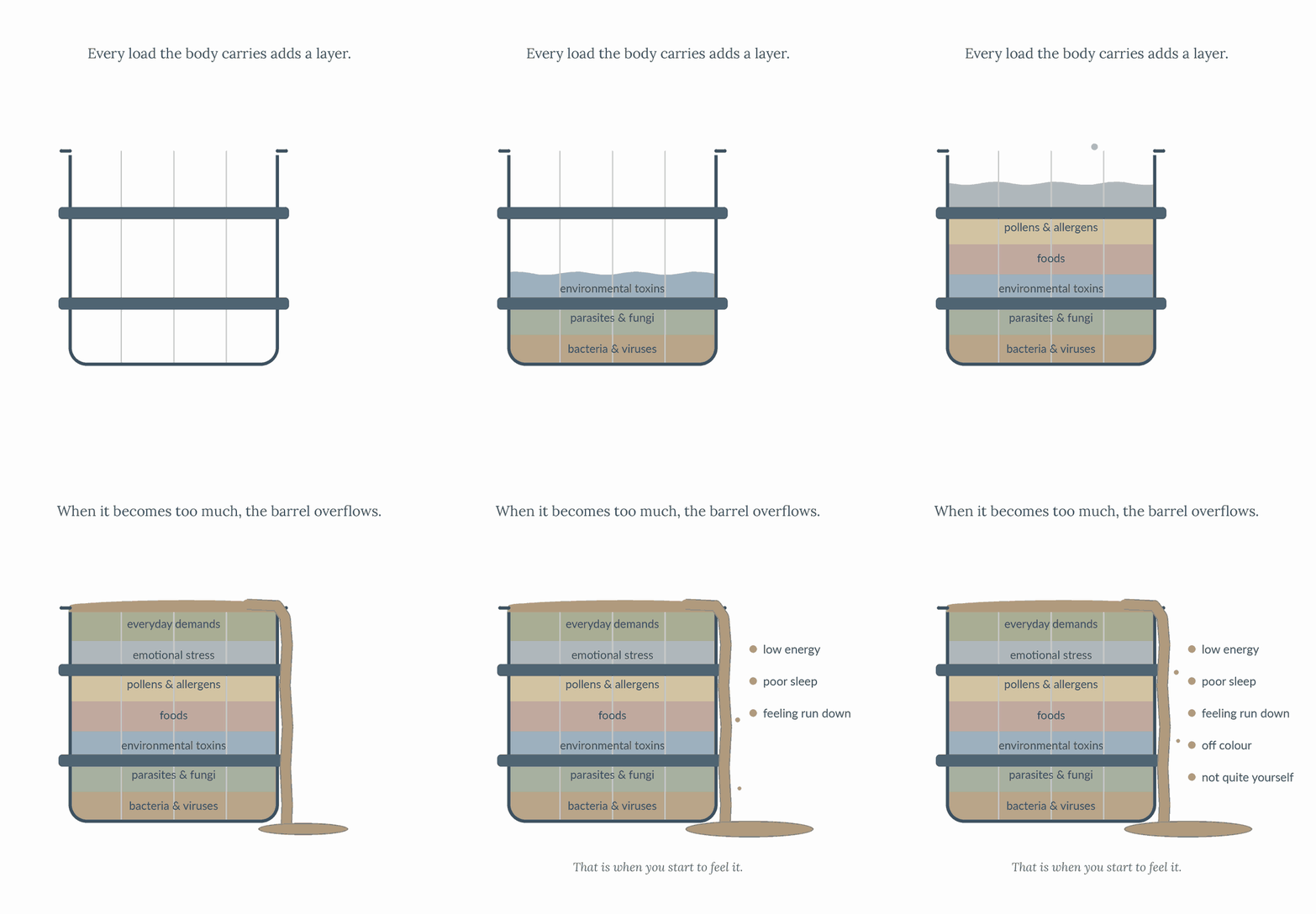
Imagine your body as a barrel.
From the moment we’re born, we’re exposed to all kinds of things: foods, pollens, environmental substances, everyday stresses and the demands we place on our bodies. Imagine each adding a little to a barrel.
When the body’s normal regulatory mechanisms are coping well, the barrel never reaches the top. But what happens when it becomes too much?
That “overflowing barrel” is one way practitioners explain why an accumulation of different stresses may matter, and why two people exposed to apparently similar things may respond very differently.
Bioresonance therapy is based around the idea of identifying and reducing some of that stress, with the aim of supporting the body’s own regulatory processes.
During a typical session, the practitioner uses applicators connected to the BICOM® device. Depending on the therapy being carried out, these may make contact with the body or be positioned over clothing.
Information is received by the device, processed according to the selected therapy programme and returned via an applicator such as the BICOM® modulation mat. A session may use several programmes and different forms of input information.
For the person having therapy, however, there’s very little to do except relax. There are no needles and the therapy is non-invasive.

Bioresonance describes an approach, not a single piece of technology. There are many devices available, with considerable differences in their development, capabilities, regulatory status, practitioner training and support.
We chose BICOM®.
Developed in Germany over more than three decades, BICOM® has become one of the most established names in bioresonance, with more than 18,000 devices in use across over 90 countries according to manufacturer information.
The BICOM® Optima is also a Class IIa medical device, registered with the MHRA for the Great Britain market.
The difference lies not in how many frequencies can be delivered, but in how precisely they can be selected.
Some approaches to frequency therapy work across a broad range of frequencies simultaneously, rather like scattering many shots in the general direction of a target.
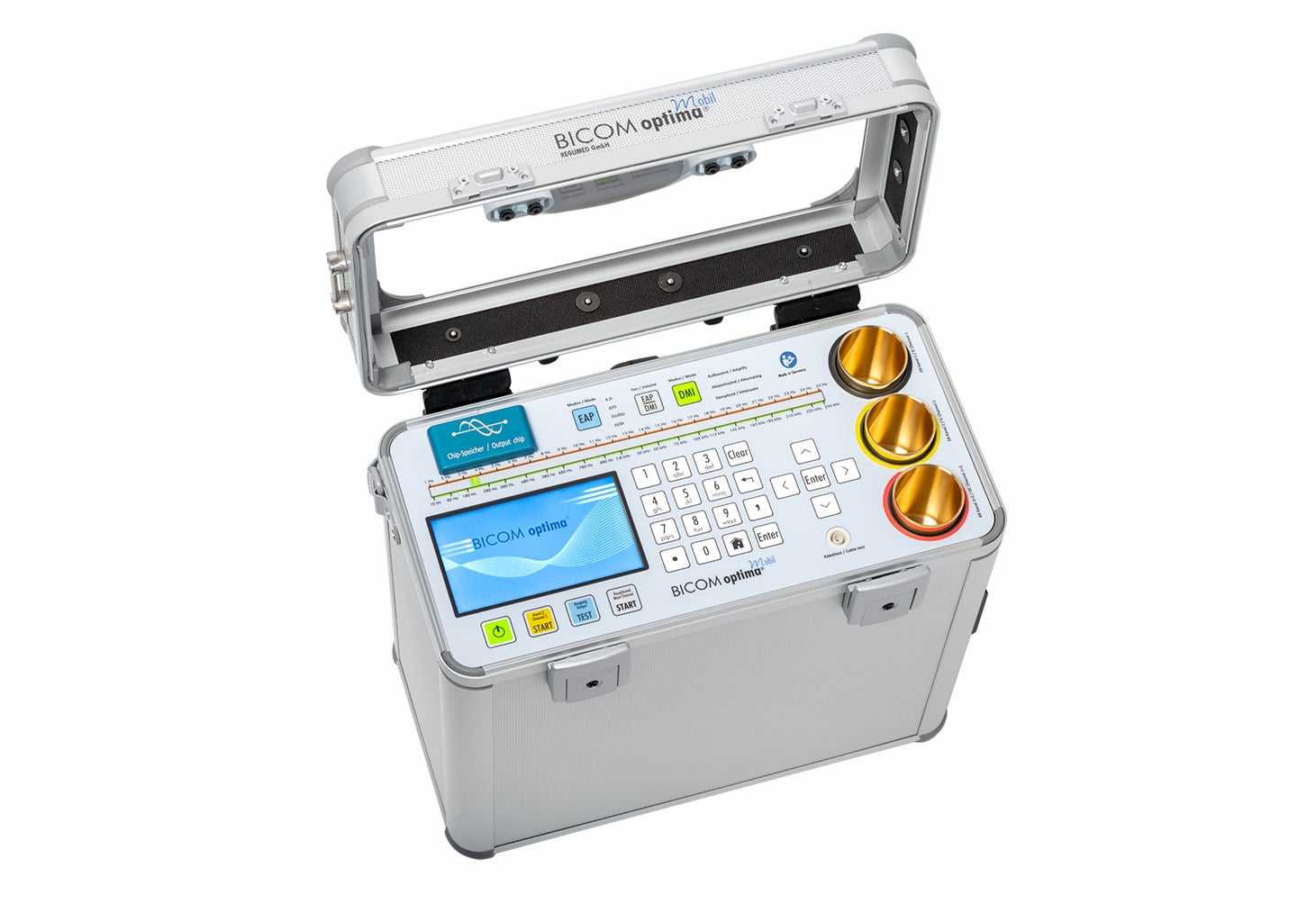
BICOM® Optima is designed for a much more targeted approach. Its extensive range of therapy possibilities allows the practitioner to select and work with specific frequency information according to the individual therapy being carried out.
It’s not about throwing more frequencies at the body. It’s about working more precisely with the information selected for that individual.
And that precision is only part of the story. BICOM® Optima brings together capabilities that might otherwise require several separate systems, effectively giving the practitioner five devices in one professional platform.
That’s one of the reasons we’ve chosen BICOM® Optima for our own clinic, our practitioner training and the professional equipment we supply.
Whether we’re providing therapy at Reson8, training a new practitioner or supplying equipment for a professional practice, BICOM® is the technology we’ve chosen to put our name behind.

There’s a lot to explore on Bioresonance.org, and you probably won’t want to absorb it all in one visit. We’ve brought much of it together in Exploring Bioresonance Therapy, our free 160-page guide to the principles, potential applications and limitations of bioresonance.
Download it and explore the subject at your own pace.
The development of BICOM® bioresonance technology dates back to work by German physician Dr Franz Morell and engineer Erich Rasche in the 1970s.
The technology developed around the concept of working with frequency information associated with the body and other substances. Modern BICOM® systems use different therapy programmes, applicators and input methods depending upon the purpose of a session.
One of the concepts used to explain part of the process is inversion. And there’s an everyday technology that makes the idea much easier to visualise.
Noise-cancelling headphones detect unwanted sound and generate an opposing signal designed to reduce it. BICOM® uses signal processing differently, but the analogy provides a simple way to introduce the concept of an inverted signal.
That’s the simple explanation. Behind it lies a considerably more technical discussion involving frequency patterns, electromagnetic signals, filters, applicators and different BICOM® therapy programmes.
If that interests you, we’ve kept going.
Our answer isn’t “believe us.” It’s: look at the information.
Bioresonance has been used internationally for decades. During that time there have been published studies, clinical observations, practitioner reports and thousands of individual experiences.
They aren’t all the same kind of evidence. A personal story isn’t a clinical trial. A practitioner’s case report isn’t the same as a peer-reviewed study. And evidence relating to one particular application shouldn’t automatically be used to make claims about another.
That’s why we’ve created a research section where you can explore the evidence for yourself. Read the papers. Look at the case studies. Explore the different applications. Consider the limitations. Then make up your own mind.
- Personal storiesReal individual experiences. Not a clinical trial.
- Practitioner case reportsObserved in practice. Not the same as a peer-reviewed study.
- Published studiesRead them, and note what each one does and does not cover.
- One application at a timeEvidence for one use should not be used to make claims about another.
- 1987The first BICOM® device was introduced.
- 90+Countries where BICOM® devices are in use.According to manufacturer information.
- Class IIaThe BICOM® Optima and Optima Mobil supplied in Great Britain are Class IIa medical devices.
Since 1987, BICOM® technology has been used by doctors, therapists and other practitioners internationally, and the devices supplied in Great Britain are subject to medical-device regulatory requirements. For us, that distinction matters.
Different devices can have different intended purposes, regulatory status, technology, training and supporting evidence. If you’re considering equipment professionally, we think you should understand those differences before making a decision.

After years navigating the conventional healthcare system with Sarah’s health, we encountered bioresonance with plenty of questions and, initially, plenty of scepticism.
What happened next eventually led us much further than we expected. It led to BICOM UK, practitioner training, our Reson8 clinic and ultimately Bioresonance.org.
This website is partly the resource we would have liked to find when we were trying to understand the subject ourselves.
At Reson8, our bioresonance clinic, you can talk to us about what has brought you to bioresonance, ask questions and understand what a BICOM® session involves before deciding whether it’s something you would like to explore.
A typical appointment lasts around 60 minutes, although treatment plans and costs vary according to individual circumstances.
For professionals, choosing a bioresonance system isn’t simply about buying a machine. It’s about understanding the technology, learning how to use it appropriately, receiving good training and having access to support as your experience develops.
BICOM UK provides BICOM® systems alongside practitioner training and ongoing professional support.
Bioresonance is a large subject. You don’t need to understand everything today, and you certainly don’t have to take everything you read at face value.
Start with the question that brought you here and follow it. Treatment. Technology. Research. Practitioner experience. Real stories.
We’ve built Bioresonance.org so that the simple explanation is always easy to find, and the deeper information is there whenever you’re ready for it.
A note on health information. Bioresonance is a complementary approach and the information on Bioresonance.org is provided for educational purposes. Information, case studies and individual experiences should not be interpreted as medical advice or as a substitute for diagnosis or treatment from an appropriately qualified healthcare professional.