
Bioresonance in veterinary practice
An animal cannot tell you where it hurts, when it started, or what it ate three weeks ago. Everything has to be worked out from the outside, and by the time a chronic problem is visible it has usually been building for months.
Bioenergetic testing gives a practice another way in. It looks for what is stressing the animal rather than starting from the symptom in front of you, and the testing itself is painless. This page collects everything on this site about that work: papers from vets in practice, therapy tips, and case notes written up by the people who treated the animal.
Start with the animal
Not about one species in particular? There are general veterinary articles as well, covering the method itself, testing, and the reasoning behind a treatment plan.
There is a page written for owners rather than for practices. What a session at your yard involves, the mobile device we bring, and how the work sits alongside your own vet.
What it looks like in practice
Paul Boland, vetA vet on why he brought bioresonance into his own practice, and what he uses it for.
One dog, one ownerAn owner’s account of what happened to their dog, told by the person who was there.
Brendan Clarke on the methodNot a case. What the testing actually does, and what happens in a session.
These are individual accounts from the people involved. They describe what those people experienced with their own animals, and are not a claim about what bioresonance will do for yours.
Two different readers
The clinical material sits in the Practitioner Library. It is free, and it opens straight away.
- The Practitioner LibraryCongress papers, including thirty years of veterinary work
- Therapy tipsProgramme numbers, applicator placement, the A to Z guides
- Test kitsIncluding the kits used in veterinary work
Start with what actually happened to other people’s animals, rather than with the theory.
- Real life accountsFrom therapists and from owners
- Case notes and articlesWritten up by the vets who did the work
- Find a therapist near youAsk us who is working in your area
BICOM devices are sold to practices rather than to the public, and most are priced on application, because what you need depends on what you already have. Tell us what you work with and we will come back with a figure.
How vets use bioresonance in their practice
Have you ever asked yourself why, despite increasing affluence and the incredible scientific advances made, more and more people and animals are suffering from allergic and chronic disorders?
This is the reason why we have developed a method which enables new approaches to be made in diagnosis and therapy:
The BICOM® bioresonance method is one of a number of procedures including homeopathy, acupuncture and other naturopathic procedures within the area of empirical healing. It has been used for over 25 years in human medicine and for more than 10 years in veterinary practice.
Our aim is to help therapists relieve symptoms and heal illnesses without any harmful side effects. To offer you the opportunity to recognise and effectively treat the often underlying physical causes rather than just the symptoms.
In the following sections we would like to provide you with information on the underlying causes of chronic health disorders and introduce you to the BICOM bioresonance method. Perhaps this will give you the opportunity to discover and treat the as yet unidentified causes of ill health in your animal. Please read each of the following sections in turn.
What is the BICOM bioresonance method?
The BICOM® bioresonance method is a special diagnostic and therapy procedure which has paved the way for a whole new approach to medicine. The following principles behind the bioresonance method are confirmed by the latest findings in biophysics and quantum mechanics*, but have been hitherto disregarded by conventional medicine.
In many cases it is possible to use the BICOM® device to pinpoint the actual, but often concealed, causes of disease.
The bioresonance method is a gentle form of therapy with no drugs or medication.
Stress factors
A number of different stresses affect animals today: additives in food (preservatives, attractants and colouring agents etc.), chemically treated drinking water, environmental toxins, electrosmog (animals are particularly sensitive to this), exhaust fumes, the use of medication etc. These stresses can become all too much for some animals. We see the results in the form of disturbances to general well-being, abnormal behaviour and even serious physical disorders. It is interesting to note that in animals with the same clinical picture, there are often completely different underlying causes. Unfortunately, it is not always possible using conventional means to pinpoint these different and highly individual causes.
However, where stresses are too numerous and chronic over a prolonged period this can put too much pressure on the animal’s ability to heal itself.
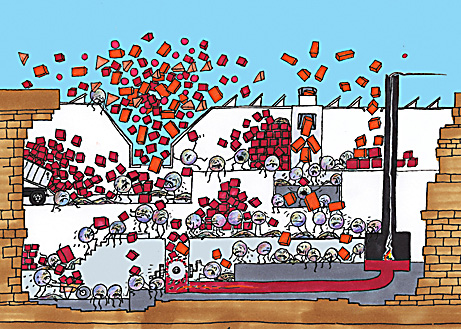
As a general rule, animals have very good self-healing powers. They possess a phenomenal regulation system which can even help to restore equilibrium over and over again in response to unusual influences acting on the body.
However, if the animal experiences too many stresses or the stresses are too acute over a prolonged period this can impede or even block its regulatory capability as well as its self-healing powers.
Major advances in technology have led to previously unimagined developments
Nowadays we can receive images across the ether and converse with people thousands of miles away. In other areas too we see rapid technological advances. Research in the area of biophysics and quantum mechanics* has opened up previously unimagined possibilities.
Such research helps explain the principles underlying the bioresonance method.
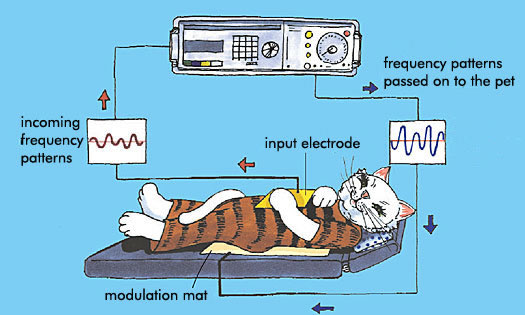
The stresses found in testing are treated using the appropriate frequency patterns
Treatment
1. Testing
With a special, painless test procedure the therapist finds out whether any intolerances are present, whether certain organs are weakened or whether toxic substances are having a negative impact on the animal’s body etc. As a result, the often underlying causes of a complaint can in many cases be discovered very quickly.
2. Therapy
In most cases an individual treatment plan is drawn up and possible complementary measures discussed.
During treatment with the BICOM® device applicators are placed on the animal which either stands, sits or lies down in a relaxed position. A treatment session usually lasts between five and 20 minutes. The therapy is completely painless.
The aim of the therapy is to reduce those factors causing the illness and so encourage communication in the animal’s body.
The number of treatments required depends on a number of factors. The owner should notify the therapist about any changes they observe in their animal.