
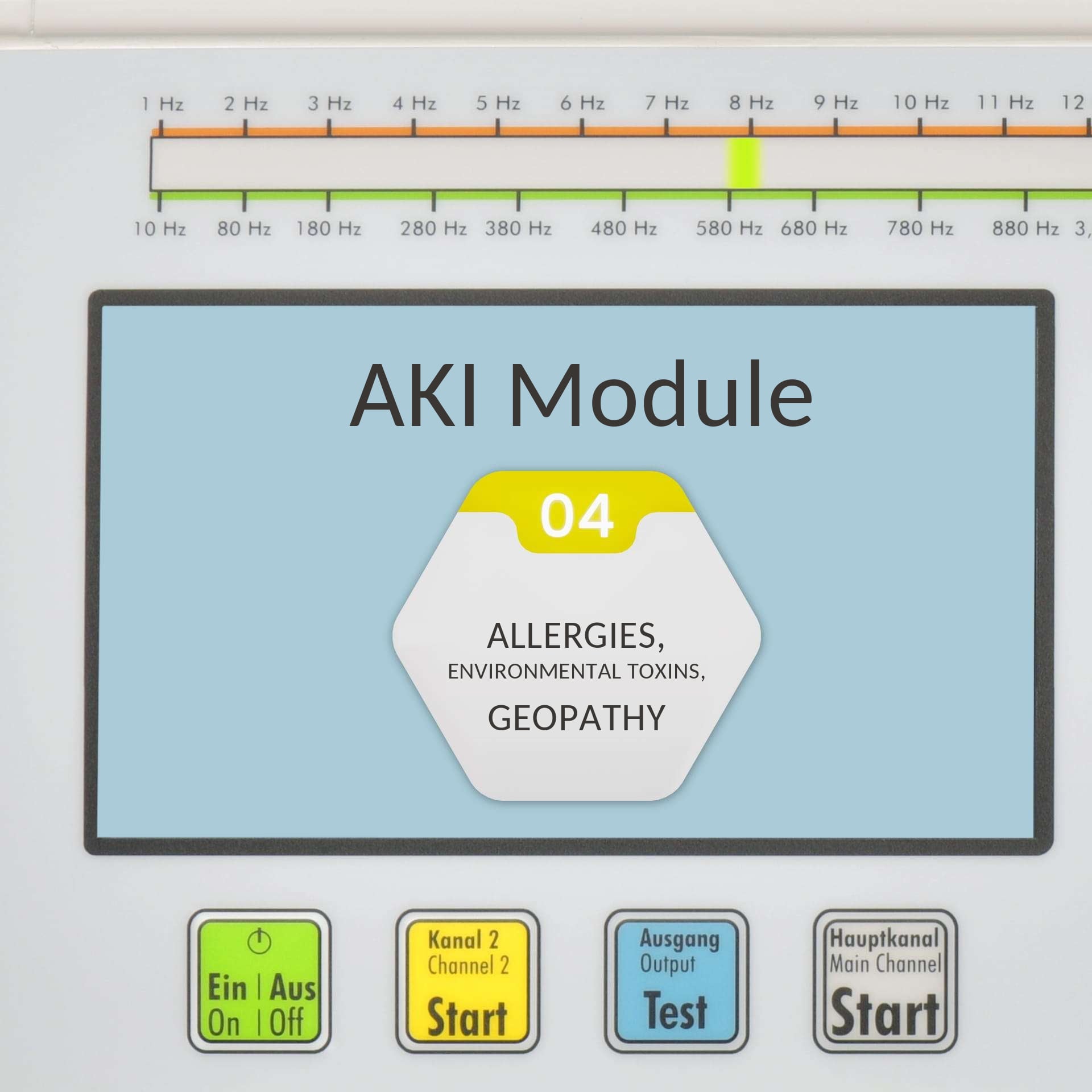
AKI specialist module 4 Allergies and Stresses
£779.00 ex. VAT
AKI specialist module 4, Allergies, environmental toxins and geopathy: 102 substance complexes for BICOM optima® 2nd generation, the largest of the six modules apart from the flower essences. Covers allergies, environmental toxins, geopathy, metabolism and autoimmunity. The environmental toxins group names fourteen substances, from benzanthracenes and captan to lindane, parathion, plasticizers and trichloroethylene. The geopathy group names the Curry grid, the Hartmann grid and geological faults. Developed with the Academy for Complementary and Information Medicine.
Art. No. GSTF4
Topic areas
Allergies, pollen and others; environmental toxins; geopathy; metabolism; autoimmunity.
Geopathy group
Three complexes, named for the grid systems they refer to:
- Curry grid
- Hartmann grid
- Geological fault
Environmental toxins group
Fourteen complexes, named for the substances they carry:
- Benzanthracenes
- Captan
- Dichlorvos (DDVP)
- Diesel soot
- Glycine
- Heavy metals
- Iron
- Lindane
- Nitrogen oxides
- Parathion
- Plasticizers
- Trichloroethylene
- Spray agents, a combined complex of the most common
- Toxins, a combined complex of the most common
What a substance complex is
Each substance complex is a digitally stored compilation of individual substances. They are not simply mixed: each complex is put together in a set ratio of quantity and strength, and a single complex can draw on up to 30 individual substances. A module of around 90 complexes therefore covers over 2,000 individual substances, and the six modules together cover more than 10,000.
Complexes can run on channel 2 alongside a BICOM® program, or be used on their own, including for making up oils and ointments.
From the AKI presentation
This is where the depth of a complex shows. The example given is the complex “milk intolerance”. It does not just carry milk. It draws together information from several categories:
- Dysbiosis
- Vaccinations
- Environmental stresses
- Organs
- Amino acids
- Orthomolecular substances
- Milk itself, as a potency code
The environmental group covers sprays, heavy metals and plasticisers, with “plasticiser stress” as the example shown. The metabolism group includes detox, malabsorption and digestion themes.
In the presentation, these complexes are filed within the existing BICOM® substance-complex categories rather than in a separate group, so they appear next to the ones you already use.
How it runs in the device
The AKI complexes are called up from main menu item 6 on the BICOM optima®, alongside the substance complexes already in your device. You can use a single complex or several together.
- With a program: run the complex in channel 2 alongside a program (menu 3) or a program sequence (menu 4).
- Therapy type A: channel 2 carries the complex as A information, with eightfold amplification. Norbert Lindner explains that this is where the second channel came from.
- Between sessions: complexes can be stored to a carrier such as oil, for clients to take home.
Where the modules come from
Developed with the Akademie für Komplementär- und Informationsmedizin (AKI), the Academy for Complementary and Information Medicine, in Malchow, Germany. Topics and contents were chosen from the experience of AKI’s application consultants, in consultation with long-standing BICOM® practitioners.
Compatibility
For BICOM optima® devices of the 2nd generation, the touch screen models: V7, V8 and VET. Not for 1st generation devices.
If you are not sure which generation your BICOM optima® is, press 9 for settings then 0 for version, and read the version number under “update”.
Watch the presentations
Reiko Wollenzin, director of AKI and a BICOM® therapist and trainer for 20 years, walks through all six modules. Norbert Lindner gives a shorter practitioner’s view of how he uses them. Both were first shown at the 2022 International Online Congress.
- Explanation of the AKI Extension Modules, Reiko Wollenzin (21 minutes)
- Explanation of the AKI Extension Modules, Norbert Lindner (5 minutes)
- AKI Extension Modules, short overview (38 seconds)
The six AKI modules
Each module stands on its own. Together they hold more than 10,000 individual pieces of information.
- Module 1, Emotions
- Module 2, Psychology
- Module 3, Sports medicine
- Module 4, Allergies, environmental toxins, geopathy (this module)
- Module 5, Flower essences
- Module 6, VET special
On the complex names
Complex names are the manufacturer’s names and describe what each complex is built around. They are not claims that a complex treats, cures or prevents any condition. The complexes carry therapy type A only and hold no strain information, even where a name reads like an indication. The modules are not a diagnostic tool, and are intended for trained BICOM® practitioners.
Source: AKI GmbH presentations of the AKI extension modules, International Online Congress 2022.
| Weight | 0.05 kg |
|---|
Be the first to review “AKI specialist module 4 Allergies and Stresses”
You must be logged in to post a review.
Related products
Software

Software
Software
Software
Reviews
There are no reviews yet.