
Test kit horse special
£825.00 ex. VAT
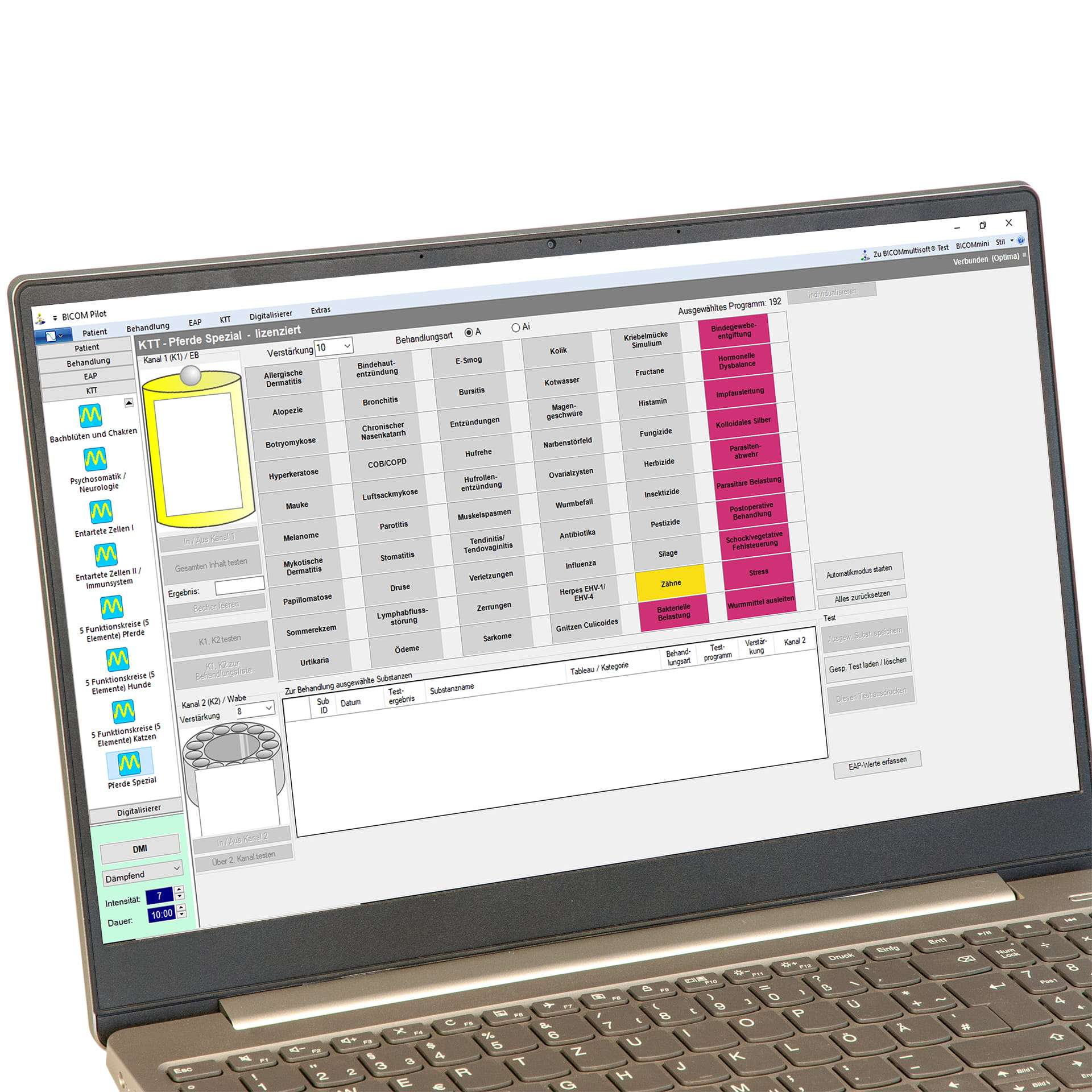
The Horses Special test set: sixty ampoules in one tableau, put together for horses. Forty-eight grey ampoules, tested with Ai, carry strain information grouped by theme across skin and coat, airways, legs and hooves, digestion, biting insects, feed such as fructan and silage, and agricultural chemicals. A yellow Teeth ampoule and eleven pink elimination and stabilising ampoules are tested with A. The labels are filing names, not diagnoses. For trained practitioners working alongside the horse’s vet. Full tableau below.
What is in the set
Sixty ampoules in one tableau, put together for horses. Forty-eight grey ampoules carry strain information grouped around themes that come up on the yard, from the skin and airways to the legs, hooves and gut, along with biting insects, feed such as fructan and silage, and agricultural chemicals. A yellow Teeth ampoule and eleven pink elimination and stabilising ampoules complete the set.
- 60 ampoules in one tableau
- 48 grey strain and clinical-picture ampoules
- 1 yellow Teeth ampoule
- 11 pink elimination and stabilising ampoules
- HS 001 to HS 060 reference numbers
How the labels work
Each grey ampoule is named after the theme its frequency information is grouped around: a clinical picture such as Laminitis or Summer itch, or a strain such as Silage or Insecticides. The label is a filing name for the information in the ampoule. It is not a diagnosis, and a resonance with an ampoule does not mean a horse has that condition.
The tableau
Laid out as the manufacturer prints it: the grey ampoules across the first four columns and most of the fifth, Teeth in yellow, and the pink ampoules down the right-hand column.
| Allergic dermatitis HS 001 |
Conjunctivitis HS 011 |
Electrosmog HS 021 |
Colic HS 031 |
Black fly/ Simulium HS 041 |
Detoxification of connective tissue HS 051 |
| Alopecia HS 002 |
Bronchitis HS 012 |
Bursitis HS 022 |
Fecal water HS 032 |
Fructan HS 042 |
Hormonal imbalance HS 052 |
| Botryomycosis HS 003 |
Chronic rhinitis HS 013 |
Inflammations HS 023 |
Gastritic ulcer HS 033 |
Histamine HS 043 |
Eliminate vaccination HS 053 |
| Hyperkeratosis HS 004 |
COB/COPD HS 014 |
Laminitis HS 024 |
Scar interference HS 034 |
Fungicides HS 044 |
Colloidal silver HS 054 |
| Mud fever HS 005 |
Guttural pouch mycosis HS 015 |
Podotrochleosis (navicular syndrome) HS 025 |
Ovarian cysts HS 035 |
Herbicides HS 045 |
Parasitic defense HS 055 |
| Melanoma HS 006 |
Parotitis HS 016 |
Muscle spasms HS 026 |
Worm infestation HS 036 |
Insecticides HS 046 |
Parasitic strain HS 056 |
| Mycotic dermatitis HS 007 |
Stomatitis HS 017 |
Tendinitis/ Tendovaginitis HS 027 |
Antibiotics HS 037 |
Pesticides HS 047 |
Post-operative care HS 057 |
| Papillomatosis HS 008 |
Strangles HS 018 |
Injuries HS 028 |
Influenza HS 038 |
Silage HS 048 |
Shock, vegetative malfunction HS 058 |
| Summer itch HS 009 |
Lymphatic drainage disorder HS 019 |
Muscle strain HS 029 |
Herpes/ EHV-1/EHV-4 HS 039 |
Teeth HS 049 |
Stress HS 059 |
| Urticaria HS 010 |
Edemata HS 020 |
Sarcomas HS 030 |
Biting midges/ Culicoides HS 040 |
Bacterial strain HS 050 |
Eliminate anthelmintics HS 060 |
Grey: strain and clinical-picture ampoules, Ai Yellow: Teeth, A Pink: elimination and stabilising, A
The grey ampoules
Forty-eight ampoules, grouped here by area to make the tableau easier to find your way around. The labels are the manufacturer’s; it notes that the contents follow the label, so no further breakdown is given.
| Group | Ampoules (HS code) | Count |
|---|---|---|
| Skin, coat and growths | Allergic dermatitis (001), Alopecia (002), Botryomycosis (003), Hyperkeratosis (004), Mud fever (005), Mycotic dermatitis (007), Papillomatosis (008), Summer itch (009), Urticaria (010), Melanoma (006), Sarcomas (030) | 11 |
| Eyes, airways, mouth and head | Conjunctivitis (011), Bronchitis (012), Chronic rhinitis (013), COB/COPD (014), Guttural pouch mycosis (015), Parotitis (016), Stomatitis (017), Strangles (018), Influenza (038), Herpes/EHV-1/EHV-4 (039) | 10 |
| Legs, hooves and muscles | Bursitis (022), Laminitis (024), Podotrochleosis (navicular syndrome) (025), Muscle spasms (026), Tendinitis/Tendovaginitis (027), Injuries (028), Muscle strain (029) | 7 |
| Digestion and internal | Colic (031), Fecal water (032), Gastritic ulcer (033), Worm infestation (036), Ovarian cysts (035) | 5 |
| General | Inflammations (023), Scar interference (034), Lymphatic drainage disorder (019), Edemata (020) | 4 |
| Biting insects | Biting midges/Culicoides (040), Black fly/Simulium (041) | 2 |
| Feed, environment and chemicals | Fructan (042), Silage (048), Histamine (043), Antibiotics (037), Electrosmog (021), Fungicides (044), Herbicides (045), Insecticides (046), Pesticides (047) | 9 |
Teeth and the pink ampoules
The yellow Teeth ampoule (HS 049) is tested in mode A; testing it with Ai gives a provocation test. The eleven pink ampoules are used in the elimination and stabilising steps, in mode A.
| Code | Ampoule |
|---|---|
| HS 050 | Bacterial strain |
| HS 051 | Detoxification of connective tissue |
| HS 052 | Hormonal imbalance |
| HS 053 | Eliminate vaccination |
| HS 054 | Colloidal silver |
| HS 055 | Parasitic defense |
| HS 056 | Parasitic strain |
| HS 057 | Post-operative care |
| HS 058 | Shock, vegetative malfunction |
| HS 059 | Stress |
| HS 060 | Eliminate anthelmintics |
What this kit is for
This is a veterinary strain kit for horses in the Combined Test Technique. It gathers the themes that matter most around horses into one tableau, so a practitioner can work through skin, airways, legs and gut in a single session and follow each resonance into the elimination and stabilising steps. The manufacturer covers its use in more depth at the REGUMED Institut veterinary seminars.
This kit is not a diagnostic test and does not replace a vet. In the UK, diagnosing and treating animals is restricted to veterinary surgeons under the Veterinary Surgeons Act 1966, and any horse showing signs of illness, lameness or colic needs a vet first.
Testing
The ampoule under test goes in the input cup of the BICOM® device, or in a honeycomb, against a grasping electrode or through the infrared transmitter.
| Ampoules | Colour | Program |
|---|---|---|
| The 48 strain and clinical-picture ampoules | Grey | Ai, 191 or 197 |
| Teeth | Yellow | A; Ai gives a provocation test |
| The 11 elimination and stabilising ampoules | Pink | A, 192 or 198; may also be used in channel 2 once tested positive with A |
Test which grey ampoules show a common resonance, and do the same for the pink ampoules; ampoules that resonate together can be used together.
On the digitised version the automatic mode does not switch between A 192 and Ai 191 for you: the manufacturer is explicit that the test mode has to be checked and set by hand each time you change test kits. Ampoules can also be tested one at a time with “Test single substance”.
Therapy sequence
The manufacturer’s sequence, with amplification and time tested at every step rather than assumed.
| Step | Patient connection | Input cup | Program |
|---|---|---|---|
| 1. Basic therapy | Input and output | Secretions or excretions where used | Basic program |
| 2. Follow-up programs | Input and output | As above | Therapy blocks, elimination organs, meridian or indication programs |
| 3. Pathogenic strain | Output only | The tested grey ampoule(s) | Ai, 191 or 197 |
| 4. Elimination | Output only | The tested pink ampoule(s) | A, 192 or 198 |
| 5. Stabilising | Output only | Priority element, meridian and pink strain ampoules from the 5 Functional Circuits set, then an attenuation ampoule if it tests positive | A, 192 or 198 |
The manufacturer also suggests transferring the information of the stabilising step onto BICOM chips, minerals or oil.
Working with other sets
The stabilising step goes back to the 5 Functional Circuits set. For a wider range of parasites, worms and environmental loads there is the Environmental Loads and Parasites kit. Our equine page shows how BICOM® is used on the yard.
On the ampoule names
The names listed are the manufacturer’s own ampoule labels, published so that the contents of the set are accurate and complete. They are not statements by this shop.
Nothing on this page is a claim that this kit prevents, detects, treats or cures any condition in horses or any other animal, or that it is an alternative to veterinary care.
Before you order
- BICOM® multisoft pilot. Required for the digitised set. The automatic mode does not set the test mode for you.
- A BICOM® device. Tested and used as a CTT set.
- Trained practitioners. Supplied for use by practitioners trained in the BICOM® method, working alongside the horse’s vet.
Ampoule names, layout and programme notes are drawn from the manufacturer’s product documentation for the Horses Special test kit (Regumed). We make no claim as to therapeutic effect.
Be the first to review “Test kit horse special”
You must be logged in to post a review.
Related products
Digital Test Kits
Digital Test Kits
Digital Test Kits
Digital Test Kits
Digital Test Kits
Digital Test Kits
Digital Test Kits
Digital Test Kits
Reviews
There are no reviews yet.