
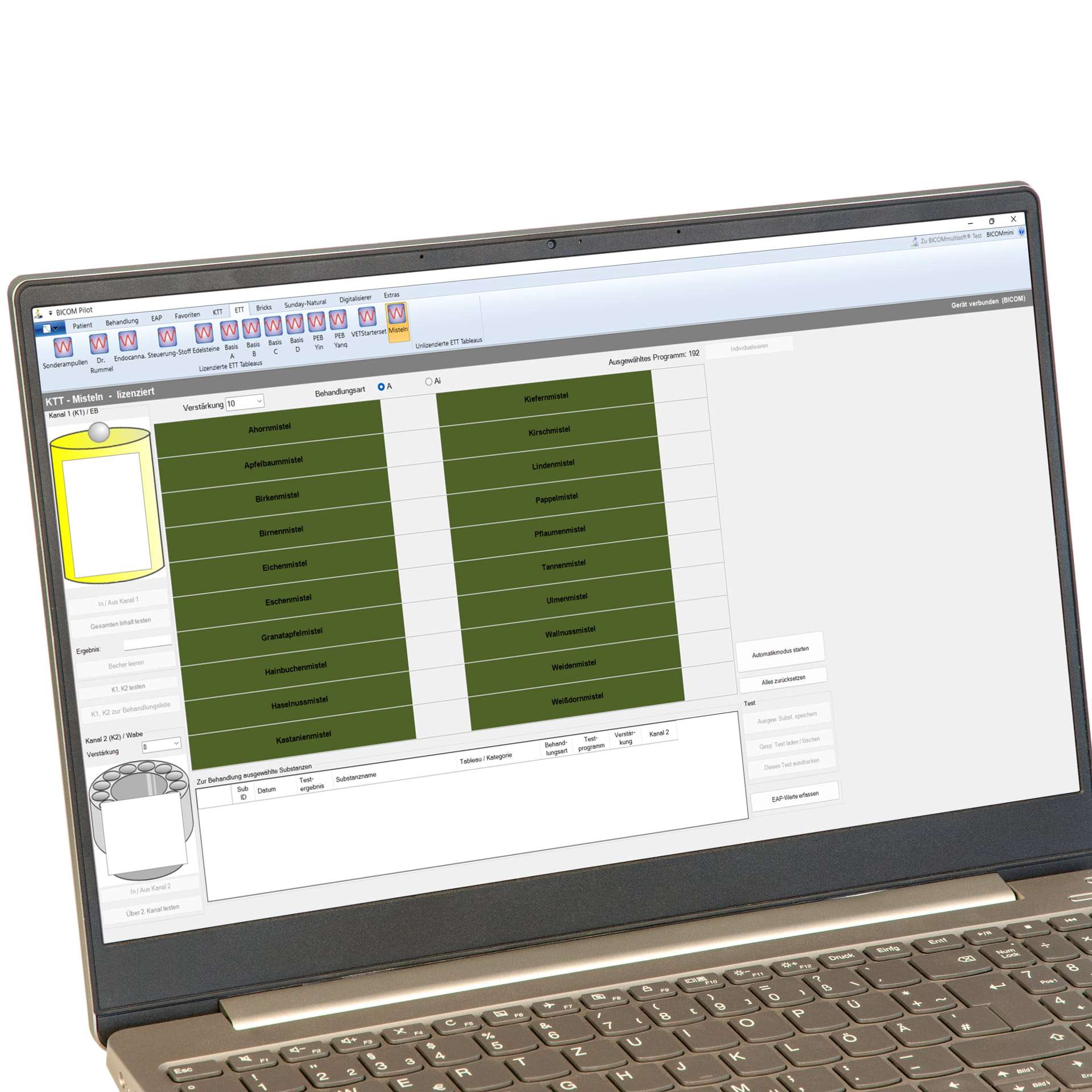
Test kit Mistletoe
£252.00 ex. VAT
The digitised Mistletoe test set: 20 ampoules, MIS 01 to MIS 20, each carrying the frequency pattern of white-berried mistletoe (Viscum album L.) grown on a different host tree, from apple and oak through to pine and fir. Bioenergetic frequency patterns only; nothing physical ships with the set. Delivered through BICOM® multisoft pilot.
Nothing physical ships with this set. As with every BICOM® test set it holds bioenergetic frequency patterns only, delivered through multisoft pilot.
What is in the set
Twenty ampoules, MIS 01 to MIS 20, each carrying the frequency pattern of white-berried mistletoe grown on a different host tree.
The host tree is the whole structure of the set, so each entry below carries its botanical name and host genus rather than a number alone.
This is the digitised set, delivered through BICOM® multisoft pilot. The software licence is a prerequisite.
- 20mistletoe ampoules
- 1species, Viscum album L.
- 192.0 Atest program
- 198.0 Atherapy program
The twenty hosts
Filter by host family, or search by tree, botanical name or code.
Nothing matches that. Try a name, a colour or a mineral class.
- Rose family 4
- Apple, pear, plum and hawthorn. Host trees of the Rosaceae.
- Oak, birch and kin 5
- Oak, chestnut, birch, hornbeam and hazel. Host trees of the order Fagales.
- Willow family 2
- Poplar and willow, the two Salicaceae hosts.
- Conifers 2
- Pine and fir, the two coniferous hosts named in the guide.
- Other broadleaf 6
- Maple, ash, linden, elm, walnut and pomegranate.
- Other 1
- Printed in the guide as Acerola, which sits outside the European host trees.
Why the host tree
One species, twenty hosts.
Every preparation relevant to therapy comes from one species, the white-berried mistletoe Viscum album L. The twenty ampoules in this set are not twenty different plants; they are the same plant grown on twenty different hosts.
That is the organising idea behind the set. Mistletoe is a hemiparasite: it takes water and minerals from the tree it grows on, and the tradition this kit comes out of treats the host tree as what differentiates one preparation from another.
The guide notes where white-berried mistletoe is commonly found: poplar and apple above all, then maple, birch, linden, black locust, willow, hawthorn and almond, and occasionally oak and elm. Among conifers it prefers pine and fir.
Using the ampoules
The manufacturer’s stated setup.
- Testing
- Program 192.0 A, with the ampoule to be tested in the input cup.
- Treatment
- Program 198.0 A. Input cup holds only the tested ampoules, no input applicators, modulation mat as the only output.
- Alternative on optima B32, B34, BM34 or Extension Module 1
- Program sequence Stabilization A 10327, same setup: only the tested ampoules in the input cup, no input applicators, modulation mat only.
- More than one resonance
- Where several ampoules test, they can go into the input cup together. They can also go into the yellow cup or honeycomb for channel 2 while a BICOM® program runs.
The manufacturer is explicit about this. Altering it means certain frequency ranges are no longer addressed, and the split-second resonance the sequence depends on is not achieved.
What the manufacturer says, and what is not on this page
The effectiveness of the mistletoe species listed here, on the body and psyche, as well as their mental effect, has neither been scientifically nor orthodoxly proven. The respective descriptions of the attributed importance in healing are excerpts from published literature and are purely informative. This information is non-binding and does not serve as a guide to therapy or diagnosis. It does not replace the professional advice of a doctor or naturopathic practitioner.
Regumed, in the foreword to this test kit’s own guide
The guide sets an attributed indication against each of the twenty ampoules. Those are not reproduced here, and the guide is not offered for download from this page, because some of that material cannot lawfully be published to the public in the United Kingdom. Practitioners who hold the set receive the guide with it.
Before you order
Required. This is a digitised test set and cannot be used without the software.
Testing on 192.0 A, treatment on 198.0 A, or sequence 10327 on optima B32, B34, BM34 or Extension Module 1.
The manufacturer specifies the modulation mat as the only output for treatment with this set.
Supplied for use by practitioners trained in the BICOM® method.
Species names, host trees and programs on this page are drawn from the manufacturer’s product documentation (Regumed, BICOM® STT Mistletoe). Botanical names appear as printed, with the ligatures dropped by the source PDF restored. We make no claim as to therapeutic effect.
Frequency patterns, not plant extracts
Nothing physical ships with this set. As with every BICOM® test set it holds bioenergetic frequency patterns only, delivered through multisoft pilot.
What is in the set
Twenty ampoules, MIS 01 to MIS 20, each carrying the frequency pattern of white-berried mistletoe grown on a different host tree.
The host tree is the whole structure of the set, so each entry carries its botanical name and host genus rather than a number alone.
This is the digitised set, delivered through BICOM® multisoft pilot. The software licence is a prerequisite.
- 20 mistletoe ampoules
- 1 species, Viscum album L.
- 192.0 A test program
- 198.0 A therapy program
The twenty hosts
| Code | Host tree | Botanical name | Host genus | Family group |
|---|---|---|---|---|
| MIS 01 | Maple | Viscum album acer | Acer | Other broadleaf |
| MIS 02 | Apple tree | Viscum album malus | Malus | Rose family |
| MIS 03 | Birch | Viscum album betula | Betula | Oak, birch and kin |
| MIS 04 | Pear | Viscum album pyrus | Pyrus | Rose family |
| MIS 05 | Oak | Viscum album quercus | Quercus | Oak, birch and kin |
| MIS 06 | Ash | Viscum album fraxinus | Fraxinus | Other broadleaf |
| MIS 07 | Pomegranate | Viscum album punica granatum | Punica | Other broadleaf |
| MIS 08 | Hornbeam | Viscum album carpinus | Carpinus | Oak, birch and kin |
| MIS 09 | Hazelnut | Viscum album corylus avellana | Corylus | Oak, birch and kin |
| MIS 10 | Chestnut | Viscum album castanea sativa | Castanea | Oak, birch and kin |
| MIS 11 | Pine | Viscum album pinus | Pinus | Conifers |
| MIS 12 | Cherry | Acerola, as printed | Acerola | Other |
| MIS 13 | Linden | Viscum album tilia | Tilia | Other broadleaf |
| MIS 14 | Poplar | Viscum album populus | Populus | Willow family |
| MIS 15 | Plum | Viscum album prunus domestica | Prunus | Rose family |
| MIS 16 | Fir | Viscum album abies | Abies | Conifers |
| MIS 17 | Elm | Viscum album ulmus | Ulmus | Other broadleaf |
| MIS 18 | Walnut | Viscum album juglans | Juglans | Other broadleaf |
| MIS 19 | Willow | no botanical name printed | Salix | Willow family |
| MIS 20 | Hawthorn | Viscum album crataegus | Crataegus | Rose family |
The host families
- Rose family, 4. Apple, pear, plum and hawthorn. Host trees of the Rosaceae.
- Oak, birch and kin, 5. Oak, chestnut, birch, hornbeam and hazel. Host trees of the order Fagales.
- Willow family, 2. Poplar and willow, the two Salicaceae hosts.
- Conifers, 2. Pine and fir, the two coniferous hosts named in the guide.
- Other broadleaf, 6. Maple, ash, linden, elm, walnut and pomegranate.
- Other, 1. Printed in the guide as Acerola, which sits outside the European host trees.
Why the host tree
Every preparation relevant to therapy comes from one species, the white-berried mistletoe Viscum album L. The twenty ampoules in this set are not twenty different plants; they are the same plant grown on twenty different hosts.
That is the organising idea behind the set. Mistletoe is a hemiparasite: it takes water and minerals from the tree it grows on, and the tradition this kit comes out of treats the host tree as what differentiates one preparation from another.
The guide notes where white-berried mistletoe is commonly found: poplar and apple above all, then maple, birch, linden, black locust, willow, hawthorn and almond, and occasionally oak and elm. Among conifers it prefers pine and fir.
Using the ampoules
- Testing. Program 192.0 A, with the ampoule to be tested in the input cup.
- Treatment. Program 198.0 A. Input cup holds only the tested ampoules, no input applicators, modulation mat as the only output.
- Alternative on optima B32, B34, BM34 or Extension Module 1. Program sequence Stabilization A 10327, same setup: only the tested ampoules in the input cup, no input applicators, modulation mat only.
- More than one resonance. Where several ampoules test, they can go into the input cup together. They can also go into the yellow cup or honeycomb for channel 2 while a BICOM® program runs.
Do not change the therapy time or amplification on sequence 10327. The manufacturer is explicit about this. Altering it means certain frequency ranges are no longer addressed, and the split-second resonance the sequence depends on is not achieved.
What the manufacturer says, and what is not here
The effectiveness of the mistletoe species listed here, on the body and psyche, as well as their mental effect, has neither been scientifically nor orthodoxly proven. The respective descriptions of the attributed importance in healing are excerpts from published literature and are purely informative. This information is non-binding and does not serve as a guide to therapy or diagnosis. It does not replace the professional advice of a doctor or naturopathic practitioner.
Regumed, in the foreword to this test kit’s own guide
The guide sets an attributed indication against each of the twenty ampoules. Those are not reproduced here, and the guide is not offered for download from this page, because some of that material cannot lawfully be published to the public in the United Kingdom. Practitioners who hold the set receive the guide with it.
Before you order
- BICOM® multisoft pilot. Required. This is a digitised test set and cannot be used without the software.
- A BICOM® device. Testing on 192.0 A, treatment on 198.0 A, or sequence 10327 on optima B32, B34, BM34 or Extension Module 1.
- Modulation mat. The manufacturer specifies the modulation mat as the only output for treatment with this set.
- Trained practitioners. Supplied for use by practitioners trained in the BICOM® method.
Species names, host trees and programs are drawn from the manufacturer’s product documentation (Regumed, BICOM® STT Mistletoe). Botanical names appear as printed, with the ligatures dropped by the source PDF restored. We make no claim as to therapeutic effect.
Be the first to review “Test kit Mistletoe”
You must be logged in to post a review.
Related products
Digital Test Kits
Digital Test Kits
Digital Test Kits
Digital Test Kits
Digital Test Kits
Digital Test Kits
Digital Test Kits
Digital Test Kits
Reviews
There are no reviews yet.