
Test kit environmental loads and parasites
£825.00 ex. VAT
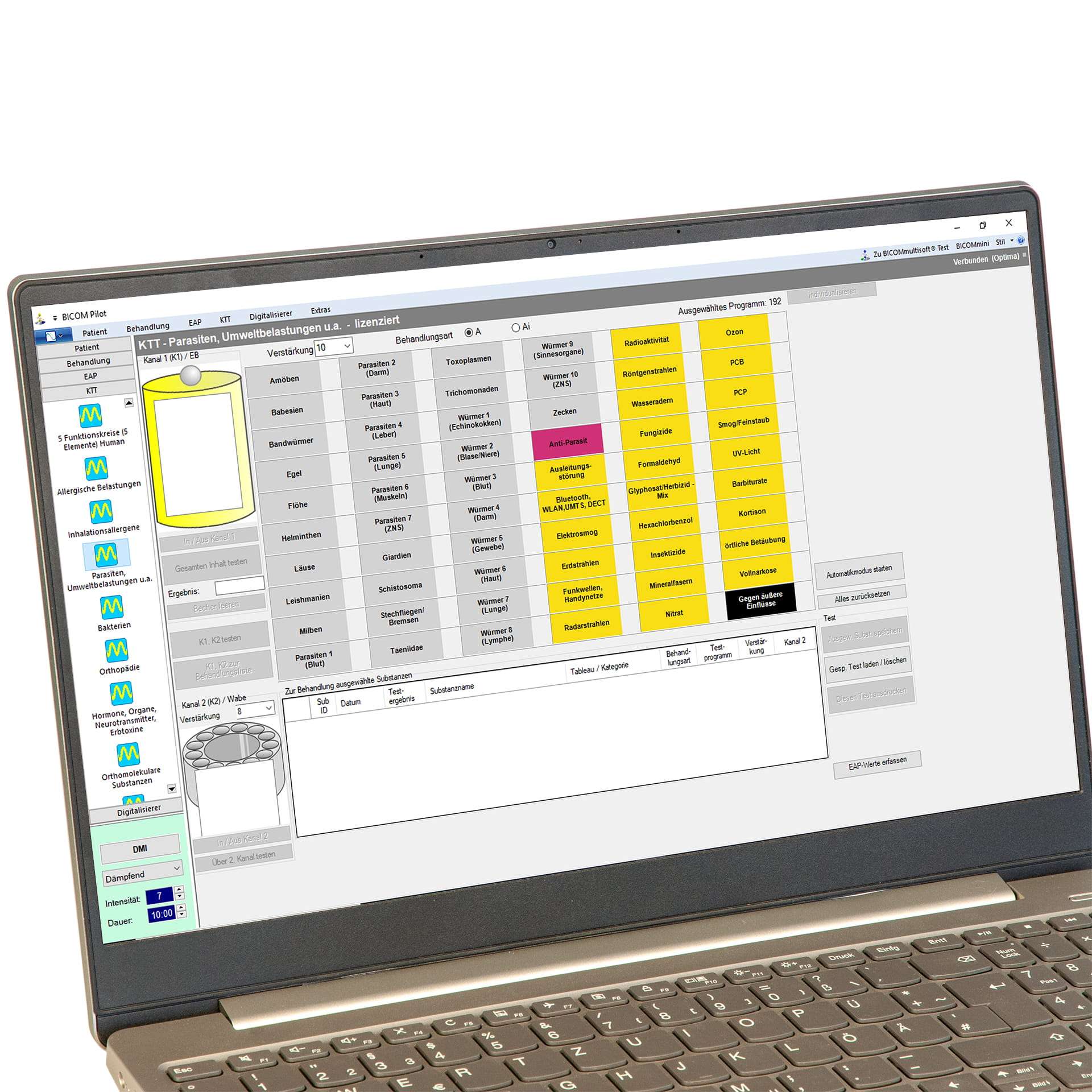
The Parasites and Environmental Loads test set: sixty ampoules in one tableau. Thirty-three grey ampoules carry parasite and worm information, from amoebae, Giardia and Toxoplasma to fleas, lice, mites, ticks, tapeworms and flukes, with worms grouped by the organ they settle in. Twenty-five yellow ampoules carry environmental loads: electrosmog, Wi-Fi and mobile networks, earth rays, radioactivity, X-rays, UV, fungicides, insecticides, glyphosate, formaldehyde, fine dust, and drugs and anaesthetics. Grey test with Ai, yellow with A or Ai, with a pink Anti Parasites and a black Against External Impact ampoule on A. Full tableau and ampoule list below.
What is in the set
Sixty ampoules in one tableau, in two halves. Thirty-three grey ampoules carry the information of parasites and worms: protozoa such as amoebae, Giardia and Toxoplasma, ectoparasites such as fleas, lice, mites and ticks, and worms grouped by where they settle, from the intestine and liver to the lungs, lymph and nervous system. Twenty-five yellow ampoules carry environmental loads: radiation and fields, agricultural and industrial chemicals, and drugs and anaesthetics. A pink Anti Parasites ampoule and a black Against External Impact ampoule complete the set.
- 60 ampoules in one tableau
- 33 grey parasite and worm ampoules
- 25 yellow environmental load ampoules
- 1 pink ampoule, Anti Parasites etc.
- 1 black ampoule, Against External Impact
- ELP 001 to ELP 067 reference numbers; ELP 016, 021, 033 to 035, 041, 055 and 057 are not used, and the manufacturer’s sheet prints ELP 039 on both Water veins and Earth Rays
The tableau
Laid out as the manufacturer prints it: the parasites and worms in the first three columns and the top of the fourth, the environmental loads filling the right-hand side, with Against External Impact in the bottom right corner.
| Amebae ELP 001 |
Parasites 2 (Intestine) ELP 010 |
Toxoplasma ELP 061 |
Worms 9 (Sensory Organs) ELP 029 |
Radioactivity ELP 052 |
Ozone ELP 048 |
| Babesia ELP 059 |
Parasites 3 (Skin) ELP 011 |
Trichomonads ELP 020 |
Worms 10 (CNS) ELP 030 |
X-Rays ELP 053 |
Biphenyl ELP 049 |
| Tapeworms ELP 002 |
Parasites 4 (Liver) ELP 012 |
Worms 1 (Echinococcosis) ELP 062 |
Ticks ELP 031 |
Water veins ELP 039 |
Pentachlorophenol ELP 050 |
| Flukes ELP 003 |
Parasites 5 (Lungs) ELP 013 |
Worms 2 (Bladder/ Kidney) ELP 022 |
Anti Parasites etc. ELP 032 |
Fungicide ELP 042 |
Smog/ Fine dust ELP 067 |
| Fleas ELP 004 |
Parasites 6 (Muscles) ELP 014 |
Worms 3 (Blood) ELP 023 |
Elimination interference ELP 063 |
Formaldehyde ELP 040 |
UV light ELP 054 |
| Helminthes ELP 005 |
Parasites 7 (CNS) ELP 015 |
Worms 4 (Intestine) ELP 024 |
Bluetooth, WLAN, UMTS, DECT ELP 064 |
Glyphosate/ Herbicide mix ELP 066 |
Barbiturate ELP 036 |
| Lice ELP 006 |
Giardia ELP 060 |
Worms 5 (Tissue) ELP 025 |
Electrosmog ELP 038 |
Hexachlorbenzene ELP 043 |
Cortisone ELP 045 |
| Leishmania ELP 007 |
Schistosoma ELP 017 |
Worms 6 (Skin) ELP 026 |
Earth Rays ELP 039 |
Insecticide ELP 044 |
Local Anesthesia ELP 037 |
| Mites ELP 008 |
Stable Fly/ Horse Fly ELP 018 |
Worms 7 (Lungs) ELP 027 |
Radio waves, mobile networks ELP 065 |
Mineral Fiber ELP 046 |
General Anesthesia ELP 056 |
| Parasites 1 (Blood) ELP 009 |
Taeniidae ELP 019 |
Worms 8 (Lymph) ELP 028 |
Radar Rays ELP 051 |
Nitrate ELP 047 |
Against External Impact ELP 058 |
Grey: parasites and worms, Ai Yellow: environmental loads, A or Ai Pink: Anti Parasites, A Black: Against External Impact, A
The parasite and worm ampoules
Thirty-three grey ampoules in code order. Several are grouped by the organ or tissue a parasite settles in; where the manufacturer names the organisms an ampoule covers, they are given here.
| Code | Name | What it covers |
|---|---|---|
| ELP 001 | Amebae | Single-celled organisms; Entamoeba histolytica, Acanthamoeba castellanii |
| ELP 002 | Tapeworms | Nine tapeworm types and families: Diphyllobothrium latum, Dipylidium caninum, Taenia multiceps, T. saginata, T. solium, Cyclophyllidea, Hymenolepis nana, Cysticercus, Echinococcus |
| ELP 003 | Flukes | Thirteen fluke types and families, including Fasciola hepatica, Clonorchis sinensis, Opisthorchis felineus, Paragonimus, Fasciolopsis buski, Eurytrema pancreaticum and Schistosoma |
| ELP 004 | Fleas | Seven flea types: chicken, human, rat, sand, rabbit, cat and dog flea |
| ELP 005 | Helminthes | Collective worm information: Platyhelminthes, nematodes, Trematoda, Schistosoma, Filarioidea, Cestoda |
| ELP 006 | Lice | Head louse, crab louse, body louse |
| ELP 007 | Leishmania | Leishmania donovani, L. braziliensis, L. infantum, L. tropica |
| ELP 008 | Mites | Mites including Demodex folliculorum, Dermanyssus gallinae, Sarcoptes, house dust, storage, flour and harvest mites |
| ELP 009 | Parasites 1 (Blood) | Blood parasites; Plasmodium, piroplasms, Trypanosoma, Schistosoma, filarial worms, Babesia, sporozoa |
| ELP 010 | Parasites 2 (Intestine) | Intestinal parasites; Trematoda, Schistosoma, cryptosporidia, coccidia |
| ELP 011 | Parasites 3 (Skin) | Ectoparasites of the skin and fur; Cimex lectularius (bed bug) |
| ELP 012 | Parasites 4 (Liver) | Liver parasites; Sarcocystis suihominis, Clonorchis sinensis |
| ELP 013 | Parasites 5 (Lungs) | Lung parasites; Paragonimus |
| ELP 014 | Parasites 6 (Muscles) | Muscle parasites; Trichinella |
| ELP 015 | Parasites 7 (CNS) | Parasites of the cerebrospinal and tissue fluid; Trypanosoma |
| ELP 017 | Schistosoma | Schistosoma, blood flukes |
| ELP 018 | Stable Fly/Horse Fly | Flies whose larvae develop in tissue (myiasis) |
| ELP 019 | Taeniidae | Tapeworm family including the beef, pork, dog and fox tapeworm |
| ELP 020 | Trichomonads | Trichomonas, a flagellate protozoan |
| ELP 022 | Worms 2 (Bladder/Kidney) | Worms of the urinary tract and kidneys; Dioctophyme renale |
| ELP 023 | Worms 3 (Blood) | Blood worms; Strongylidae |
| ELP 024 | Worms 4 (Intestine) | Intestinal worms; ascarids, Echinostoma, Ancylostoma duodenale, Strongylidae, Enterobius vermicularis |
| ELP 025 | Worms 5 (Tissue) | Worms lodging in tissue; Toxocara, larva migrans |
| ELP 026 | Worms 6 (Skin) | Worms entering through the skin; nematodes, Moniliformis, Onchocerca volvulus |
| ELP 027 | Worms 7 (Lungs) | Lung worms; Paragonimidae, Pentastomida, with Pneumocystis carinii |
| ELP 028 | Worms 8 (Lymph) | Lymphatic filarial worms; Filarioidea, Wuchereria bancrofti, Brugia malayi |
| ELP 029 | Worms 9 (Sensory Organs) | Worms of the sensory organs; Pentastomida, Linguatula serrata |
| ELP 030 | Worms 10 (CNS) | Worms of the central nervous system; Taenia solium, Taenia multiceps, Echinococcus, nematodes, schistosomes, trematodes |
| ELP 031 | Ticks | Ticks, including Ixodidae |
| ELP 059 | Babesia | Single-celled blood parasites carried by ticks; Babesia divergens, B. microti |
| ELP 060 | Giardia | Giardia lamblia, an intestinal protozoan |
| ELP 061 | Toxoplasma | Toxoplasma gondii, an intracellular protozoan with the cat as final host |
| ELP 062 | Worms 1 (Echinococcosis) | Echinococcus granulosus (dog tapeworm), E. multilocularis (fox tapeworm) |
The environmental load ampoules
Twenty-five yellow ampoules, grouped by type. Each carries the frequency information of the load named on its label.
Radiation and fields
| Code | Name | What it covers |
|---|---|---|
| ELP 052 | Radioactivity | Plutonium, radon, radium, gamma radiation |
| ELP 053 | X-Rays | X-ray exposure |
| ELP 039 | Water veins | Radiation from water veins |
| ELP 039 | Earth Rays | Water veins, geological faults, Curry grid, Hartmann grid |
| ELP 038 | Electrosmog | Microwaves, mains and railway current, low frequency 16 2/3 Hz and 5 Hz, radio waves |
| ELP 064 | Bluetooth, WLAN, UMTS, DECT | Wi-Fi, smartphone, Bluetooth, UMTS and DECT frequencies |
| ELP 065 | Radio waves, mobile networks | C, D and E mobile networks, HAARP, DECT pulse frequency |
| ELP 051 | Radar Rays | Radar and microwave emissions from radar equipment |
| ELP 054 | UV light | UV-A, UV-B and UV-C from sunlight and lamps |
Chemicals and pollutants
| Code | Name | What it covers |
|---|---|---|
| ELP 048 | Ozone | Ozone (O3), as produced by air purifiers and photocopiers |
| ELP 049 | Biphenyl | Polychlorinated biphenyls (PCBs), formerly used in transformers, capacitors, sealants and plastics |
| ELP 050 | Pentachlorophenol | Pentachlorophenol (PCP), a chlorinated wood and leather preservative |
| ELP 042 | Fungicide | Fungicides used in agriculture and plant protection |
| ELP 040 | Formaldehyde | Formaldehyde (methanal), used in textiles, cosmetics, polymers and disinfection |
| ELP 066 | Glyphosate/Herbicide mix | Weed killers containing glyphosate |
| ELP 043 | Hexachlorbenzene | Hexachlorobenzene, a former fungicide and wood preservative |
| ELP 044 | Insecticide | Insecticides from agriculture, forestry, material protection and hygiene use |
| ELP 046 | Mineral Fiber | Glass fibre, mineral wool and other inorganic insulation fibres |
| ELP 047 | Nitrate | Nitrates, mainly from fertiliser |
| ELP 067 | Smog/Fine dust | Fine dust from industry, traffic, domestic heating and animal husbandry |
Drugs and anaesthetics
| Code | Name | What it covers |
|---|---|---|
| ELP 036 | Barbiturate | Barbiturates, a class of sedative drugs |
| ELP 045 | Cortisone | Synthetic cortisone acetate |
| ELP 037 | Local Anesthesia | Local anaesthetics |
| ELP 056 | General Anesthesia | General anaesthetics |
Elimination
| Code | Name | What it covers |
|---|---|---|
| ELP 063 | Elimination interference | Elimination of environmental loads in general |
The pink and black ampoules
| Code | Name | Used for |
|---|---|---|
| ELP 032 | Anti Parasites etc. | Elimination and stabilising after the parasite ampoules |
| ELP 058 | Against External Impact | External environmental and energetic influences; always tested |
What this kit is for
This is a pathogenic strain kit in the Combined Test Technique. In a typical sequence the 5 Functional Circuits set is tested first; when its pink strain ampoules for parasites or environmental loads resonate, this is the kit the test moves to. The manufacturer’s advice is to test every ampoule in the set once one of these loads is suspected, because a single kit covers both parasites and environment.
A positive test means the frequency information of the ampoule fits. The manufacturer is clear that the parasite or worm does not have to be present in substance. The manufacturer’s guide carries notes on each parasite and substance; that material is not reproduced here, and this kit is not a diagnostic test for any infestation, infection or exposure.
Testing
The ampoule under test goes in the input cup of the BICOM® device, or in a honeycomb, against a grasping electrode or through the infrared transmitter. Testing can be done with the tensor, by kinesiology or by EAP.
| Ampoules | Colour | Program |
|---|---|---|
| The 33 parasite and worm ampoules | Grey | Ai, 191 or 197 |
| The 25 environmental load ampoules | Yellow | A, 192 or 198; or Ai, 191 or 197, as a provocation test |
| Anti Parasites etc. | Pink | A, 192 or 198 |
| Against External Impact | Black | A, 192 or 198 |
Grey ampoules that show a common resonance may be used together. For the yellow ampoules the manufacturer distinguishes the two modes: A is used to stabilise, Ai to provoke. The black Against External Impact ampoule should always be tested, and is the one to try when no other cause shows up.
On the digitised version the automatic mode does not switch between A 192 and Ai 191 for you: the manufacturer is explicit that the test mode has to be checked and set by hand each time you change test kits. Ampoules can also be tested one at a time with “Test single substance”.
Therapy sequence
The manufacturer’s sequence, with amplification and time tested at every step rather than assumed.
| Step | Patient connection | Input cup | Program |
|---|---|---|---|
| 1. Basic therapy | Input and output | Patient secretions or excretions where used | Basic program |
| 2. Follow-up programs | Input and output | As above | Therapy blocks, elimination organs, meridian or indication programs |
| 3. Pathogenic strain | Output only | The tested grey ampoule(s); the tested yellow ampoule(s); Against External Impact | Grey: Ai, 191 or 197. Yellow: A, or Ai then A if they tested with both. Black: A |
| 4. Elimination | Output only | Anti Parasites etc. | A, 192 or 198 |
| 5. Stabilising | Output only | Priority element, meridian and pink strain ampoules from the 5 Functional Circuits set, then an attenuation ampoule if it tests positive | A, 192 or 198 |
For the third step the manufacturer notes that it has found it useful to prepare drops only, used according to the test. The Against External Impact information can also be transferred onto BICOM minerals, oil or chips, and the manufacturer suggests the same for the stabilising step.
Working with other sets
The 5 Functional Circuits set points to this kit through its pink strain ampoules, and the stabilising step goes back to it for the priority element, meridian and strain ampoules. For a wider range of chemical and metal loads there is the Environmental Toxins kit, and tick-borne bacteria such as Borrelia are in the Bacteria kit. If you already own an earlier version of this set, the Upgrade for Environmental Loads and Parasites adds the newer ampoules.
On the ampoule names
The names listed are the manufacturer’s own ampoule labels, published so that the contents of the set are accurate and complete. They are not statements by this shop.
Nothing on this page is a claim that this kit prevents, detects, treats or removes any parasite, infection, exposure or condition, or that it is an alternative to medical or veterinary care. Anyone with a suspected parasite or infection should see a doctor or vet.
Before you order
- BICOM® multisoft pilot. Required for the digitised set. The automatic mode does not set the test mode for you.
- A BICOM® device. Tested and used as a CTT set.
- Trained practitioners. Supplied for use by practitioners trained in the BICOM® method.
Ampoule names, layout and programme notes are drawn from the manufacturer’s product documentation for the Parasites and Environmental Loads test kit (Regumed). We make no claim as to therapeutic effect.
Be the first to review “Test kit environmental loads and parasites”
You must be logged in to post a review.
Related products
Digital Test Kits
Special test kit borrelia (s. RTI 41, Pauli for instructions)
Digital Test Kits
Digital Test Kits
Digital Test Kits
Digital Test Kits
Digital Test Kits
Special test kit chlamydia (s. RTI 42, Hennecke for instructions)

Digital Test Kits
Digital Test Kits
Reviews
There are no reviews yet.