
Test kit bacteria
£722.00 ex. VAT
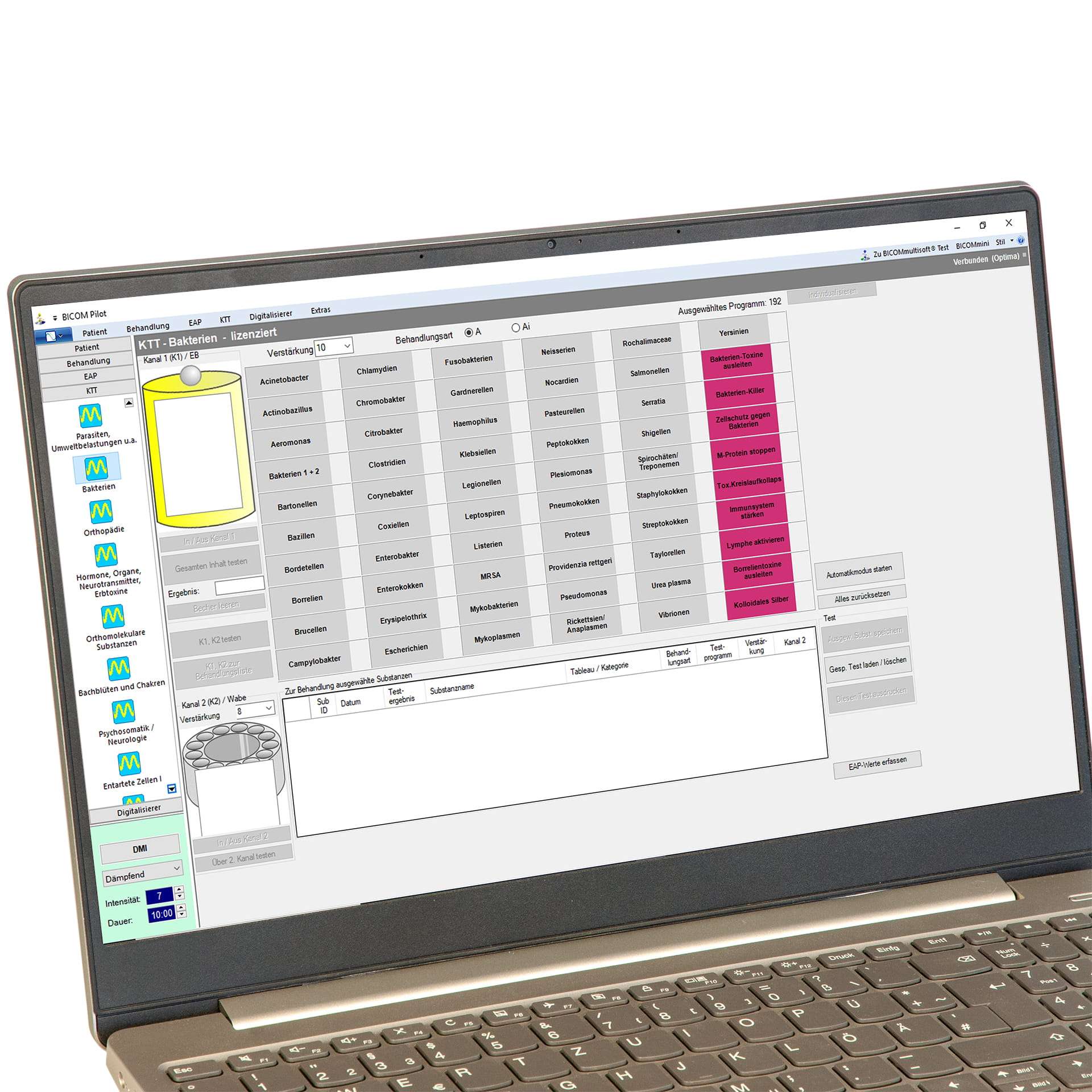
The Bacteria test set: sixty ampoules in one tableau. Fifty-one grey ampoules carry bacterial information, one genus per ampoule for most, from Acinetobacter, Bartonella, Borrelia and Chlamydia through Mycoplasma, Staphylococci and Streptococci to Yersinia, with MRSA and Rickettsia/Anaplasma. Nine pink ampoules are used in the elimination step. Grey ampoules test with Ai, pink with A. The pathogenic strain kit the 5 Functional Circuits set points to through its Bacterial strain ampoule. Full tableau and ampoule list below.
What is in the set
Sixty ampoules in one tableau. Fifty-one grey ampoules carry bacterial information, mostly one genus per ampoule, from Acinetobacter to Yersinia; the manufacturer says between them they cover more than a hundred bacteria. Nine pink ampoules complete the set and are used in the elimination step after the grey ampoules.
- 60 ampoules in one tableau
- 51 grey bacteria ampoules
- 9 pink elimination and support ampoules
- B 001 to B 064 reference numbers; B 004, 005, 023 and 038 are not used
The tableau
Laid out as the manufacturer prints it: the grey bacteria in the first five columns and the top of the sixth, the pink ampoules down the rest of the right-hand column.
| Acineto Bacteria B 001 |
Chlamydia B 011 |
Fusobacterium B 021 |
Neisseria B 030 |
Rochalimaceae B 039 |
Yersinia B 047 |
| Actinobacillus B 002 |
Chromobacterium B 012 |
Gardnerella B 057 |
Nocardia B 031 |
Salmonella B 040 |
Elimination of Bacteria Toxins B 048 |
| Aeromonas B 003 |
Citrobacter B 013 |
Haemophilus B 022 |
Pasteurella B 032 |
Serratia B 041 |
Bacteria Killer B 049 |
| Bacteria 1+2 B 055 |
Clostridia B 014 |
Klebsiella B 024 |
Peptococcus B 037 |
Shigella B 042 |
Cell protection against Bacteria B 050 |
| Bartonella B 056 |
Corynebacterium B 015 |
Legionella B 025 |
Plesiomonas B 035 |
Spirochetes/ Treponema B 061 |
Stop M-Protein B 051 |
| Bacilli B 006 |
Coxiella B 016 |
Leptospiral B 026 |
Pneumococcus B 059 |
Staphylococci B 043 |
Toxic Circulatory Collapse B 052 |
| Bordetella B 008 |
Enterobacter B 017 |
Listeria B 027 |
Proteus B 034 |
Streptococci B 044 |
Strengthening of Immune System B 053 |
| Borrelia B 007 |
Enterococci B 018 |
MRSA B 058 |
Providencia rettgeri B 033 |
Taylorella B 045 |
Activating Lymph B 054 |
| Brucella B 009 |
Erysipelothrix B 019 |
Mycobacterium B 028 |
Pseudomonas B 036 |
Urea plasma B 046 |
Eliminate borrelia toxins B 063 |
| Campylobacter B 010 |
Escherichia B 020 |
Mycoplasma B 029 |
Rickettsia/ Anaplasma B 060 |
Vibrio B 062 |
Colloidal silver B 064 |
Grey: bacteria, Ai program Pink: elimination and support, A program
The bacteria ampoules
Fifty-one grey ampoules, listed alphabetically. Where the manufacturer names the species an ampoule covers, they are given here so you can see what it contains.
| Code | Name | What it covers |
|---|---|---|
| B 001 | Acineto Bacteria | Acinetobacter; Gram-negative, often multi-resistant |
| B 002 | Actinobacillus | Gram-negative |
| B 003 | Aeromonas | Gram-negative, gas-forming rods found in surface water |
| B 006 | Bacilli | Spore-forming Gram-positive rods; Bacillus subtilis, B. thuringiensis, B. anthracis |
| B 055 | Bacteria 1+2 | Bacteria the manufacturer describes as medically unclassified |
| B 056 | Bartonella | Insect-borne, intracellular; B. bacilliformis, quintana, henselae, clarridgeiae, elizabethae, grahamii and vinsonii subspecies |
| B 008 | Bordetella | Gram-negative short rods; B. pertussis, B. bronchiseptica, B. parapertussis |
| B 007 | Borrelia | Spiral bacteria carried by ticks and lice; B. burgdorferi, duttonii, hermsii, hispanica, recurrentis, turicatae |
| B 009 | Brucella | Gram-negative short rods; B. abortus, canis, melitensis, neotomae, ovis, suis |
| B 010 | Campylobacter | Gram-negative spiral rods; C. jejuni, coli, lari, cinaedi, fetus, hyointestinalis and others, with C. pylori (Helicobacter pylori) |
| B 011 | Chlamydia | Gram-negative, intracellular; C. psittaci, C. trachomatis, C. pneumoniae |
| B 012 | Chromobacterium | Gram-negative, pigment-forming rods from soil and water |
| B 013 | Citrobacter | Gram-negative enterobacteria; C. amalonaticus, C. diversus, C. freundii |
| B 014 | Clostridia | Gram-positive, spore-forming anaerobes; C. perfringens, tetani, difficile, botulinum, septicum, novyi, sordellii and others |
| B 015 | Corynebacterium | Gram-positive rods; C. diphtheriae, pyogenes, renale, equi, xerosis |
| B 016 | Coxiella | Gram-negative, obligate intracellular; Coxiella burnetii |
| B 017 | Enterobacter | Gram-negative rods of the normal intestinal flora |
| B 018 | Enterococci | Gram-positive cocci |
| B 019 | Erysipelothrix | Gram-positive rods carried by pigs and fish |
| B 020 | Escherichia | Gram-negative rods; E. coli, including ETEC, EHEC, EPEC and EIEC strains |
| B 021 | Fusobacterium | Gram-negative, non-spore-forming rods; F. necrophorum |
| B 057 | Gardnerella | Rod-shaped bacteria of the vaginal flora |
| B 022 | Haemophilus | Gram-negative rods; H. influenzae, aegyptius, ducreyi, parainfluenzae |
| B 024 | Klebsiella | Gram-negative rods; K. oxytoca, K. pneumoniae |
| B 025 | Legionella | Gram-negative, water-borne rods; L. pneumophila |
| B 026 | Leptospiral | Leptospira; Gram-negative, screw-shaped |
| B 027 | Listeria | Gram-positive rods |
| B 058 | MRSA | Methicillin-resistant Staphylococcus aureus |
| B 028 | Mycobacterium | Acid-fast rods; M. tuberculosis, avium, bovis, leprae |
| B 029 | Mycoplasma | Bacteria without a cell wall; M. pneumoniae, mycoides, fermentans, genitalium |
| B 030 | Neisseria | Gram-negative diplococci; N. gonorrhoeae, N. meningitidis |
| B 031 | Nocardia | Gram-positive, slender rods from soil and wetland |
| B 032 | Pasteurella | Gram-negative rods found in mammals and birds |
| B 037 | Peptococcus | Gram-positive cocci of the gut flora |
| B 035 | Plesiomonas | Gram-negative rods; P. shigelloides |
| B 059 | Pneumococcus | Streptococcus pneumoniae; Gram-positive diplococci |
| B 034 | Proteus | Gram-negative rods; P. mirabilis, P. vulgaris |
| B 033 | Providencia rettgeri | Gram-negative rods |
| B 036 | Pseudomonas | Gram-negative, biofilm-forming rods; P. aeruginosa |
| B 060 | Rickettsia/Anaplasma | Gram-negative, obligate intracellular, carried by arthropods; includes Anaplasma phagocytophilum |
| B 039 | Rochalimaceae | Alphaproteobacteria, now grouped with the Bartonellaceae; Rochalimaea quintana |
| B 040 | Salmonella | Gram-negative rods; S. enteritidis, paratyphi, typhi, typhimurium |
| B 041 | Serratia | Gram-negative rods from the gut, soil and water |
| B 042 | Shigella | Gram-negative rods |
| B 061 | Spirochetes/Treponema | Spiral bacteria: Brachyspiraceae, Leptospiraceae, Spirochaetaceae; Treponema pallidum, T. pertenue |
| B 043 | Staphylococci | Gram-positive cocci in clusters; S. aureus, S. epidermidis, S. intermedius |
| B 044 | Streptococci | Gram-positive cocci, alpha and beta haemolytic; S. agalactiae, S. pyogenes, viridans streptococci |
| B 045 | Taylorella | Gram-negative, coccoid; T. equigenitalis |
| B 046 | Urea plasma | Ureaplasma, formerly called T-mycoplasma |
| B 062 | Vibrio | Gram-negative, fresh and salt water; V. cholerae, V. parahaemolyticus, V. vulnificus |
| B 047 | Yersinia | Gram-negative rods; Y. enterocolitica, Y. pestis, Y. pseudotuberculosis |
The pink ampoules
Nine pink ampoules, tested and used in therapy mode A after the grey ampoules. The labels are the manufacturer’s.
| Code | Name | Relates to |
|---|---|---|
| B 048 | Elimination of Bacteria Toxins | Bacterial toxins |
| B 049 | Bacteria Killer | Entero- and endotoxins |
| B 050 | Cell protection against Bacteria | Bacterial toxins at cell level |
| B 051 | Stop M-Protein | M-proteins of the streptococcal cell wall |
| B 052 | Toxic Circulatory Collapse | Information relating to toxic shock |
| B 053 | Strengthening of Immune System | The immune system |
| B 054 | Activating Lymph | Lymph drainage |
| B 063 | Eliminate borrelia toxins | Borrelia toxins |
| B 064 | Colloidal silver | Information of colloidal silver |
What this kit is for
This is a pathogenic strain kit in the Combined Test Technique. In a typical sequence the 5 Functional Circuits set is tested first; when its pink Bacterial strain ampoule resonates, this is the kit the test moves to. The grey ampoules are tested to find the bacterial information involved, and the pink ampoules follow in the elimination step.
The manufacturer’s guide carries a microbiology note on each genus. That material is not reproduced here, and this kit is not a diagnostic test for any infection.
Testing
The ampoule under test goes in the input cup of the BICOM® device, or in a honeycomb, against a grasping electrode or through the infrared transmitter. Testing can be done with the tensor, by kinesiology or by EAP.
| Ampoules | Colour | Program |
|---|---|---|
| The 51 bacteria ampoules | Grey | Ai, 191 or 197 |
| The 9 elimination and support ampoules | Pink | A, 192 or 198 |
On the digitised version the automatic mode does not switch between A 192 and Ai 191 for you: the manufacturer is explicit that the test mode has to be checked and set by hand each time you change test kits. Ampoules can also be tested one at a time with “Test single substance”.
Therapy sequence
The manufacturer’s sequence, with amplification and time tested at every step rather than assumed.
| Step | Patient connection | Input cup | Program |
|---|---|---|---|
| 1. Basic therapy | Input and output | Patient secretions or excretions where used | Basic program |
| 2. Follow-up programs | Input and output | As above | Therapy blocks, elimination organs, meridian or indication programs |
| 3. Pathogenic strain | Output only | The tested grey ampoule(s) from this kit | Ai, 191 or 197 |
| 4. Elimination | Output only | The tested pink ampoule(s) from this kit | A, 192 or 198 |
| 5. Stabilising | Output only | Priority element, meridian and pink strain ampoules from the 5 Functional Circuits set, then an attenuation ampoule if it tests positive | A, 192 or 198 |
The manufacturer also suggests transferring the information of the stabilising step onto BICOM chips, minerals or oil.
Working with other sets
The 5 Functional Circuits set points to this kit through its Bacterial strain ampoule, and the stabilising step goes back to it for the priority element, meridian and strain ampoules. For more detail on two of the genera here, there are separate special kits: Special test kit borrelia and Special test kit chlamydia.
On the ampoule names
The names listed are the manufacturer’s own ampoule labels, published so that the contents of the set are accurate and complete. They are not statements by this shop.
Nothing on this page is a claim that this kit prevents, detects, treats or reverses any infection or condition, or that it is an alternative to medical or veterinary care. Anyone with a suspected infection should see a doctor or vet.
Before you order
- BICOM® multisoft pilot. Required for the digitised set. The automatic mode does not set the therapy mode for you.
- A BICOM® device. Tested and used as a CTT set.
- Trained practitioners. Supplied for use by practitioners trained in the BICOM® method.
Ampoule names, layout and programme notes are drawn from the manufacturer’s product documentation for the Bacteria test kit (Regumed). We make no claim as to therapeutic effect.
Be the first to review “Test kit bacteria”
You must be logged in to post a review.
Related products
Digital Test Kits
Digital Test Kits
Digital Test Kits
Digital Test Kits
Digital Test Kits
Digital Test Kits
Digital Test Kits
Digital Test Kits
Reviews
There are no reviews yet.