
Bacterial load, Infectious disease, general, Therapy tip, Therapy Tips
Making the invisible visible: unmasking
This therapy suggestion from the AKI team (October 2026) describes how practitioners use the “Unmask” ampoule and programme 3136.0 as part of energetic testing. It is shared for BICOM users as the authors’ practice guidance, not as a medical claim. Bioresonance is a complementary approach and should always be used alongside, not instead of, care from the client’s GP or vet.
Why unmasking is used
The authors note that some intracellular loads, such as viruses and certain bacteria, are thought to “camouflage” themselves from the immune system, which can make energetic testing harder. A practitioner may suspect a particular load yet find no resonance on testing. In these cases the authors suggest a few ways to make the intracellular stress “visible” before testing.
The CTT test kit “5 functional circuits (5 elements)” contains an ampoule called “Unmask”. It is the same ampoule found in the CTT test kit degenerated cells I. The authors use it before testing for intracellular stress, or before testing with the degenerated cells I kit.
1. Classic use of the “Unmask” ampoule
- Place the “Unmask” ampoule in channel 1 (input cup).
- The client holds the cylindrical or brass ball applicators, connected to the device output with the red cables. For a small child or an animal, the modulation mat can be used as the output instead.
- Transfer the ampoule information with programme 192.0 for 3 minutes.
- Remove the ampoule from the input cup and go on to test the ampoules you wanted to unmask (for example viruses, bacteria or degenerated cells).
2. Using programme 3136.0
Programme 3136.0 is also used for intracellular stress, and appears in other tips such as The adrenal gland in the BICOM practice. The authors use it both before testing and as a “cell opener” before therapy.
a. Before testing
- The client’s own information (blood or saliva) goes in the input cup. An input applicator can also be placed over the solar plexus.
- The “Unmask” ampoule goes in channel 2.
- Set the time to 3 minutes, with the client connected to the output via the modulation mat (or the cylindrical or brass ball applicators as in method 1).
- After the programme, test the loads as usual.
b. Before therapy
- The client’s own information (blood or saliva) goes in the input cup, with an optional input applicator over the solar plexus.
- The time can be adapted to the individual.
- The programme is run as a “cell opener” before the programme chosen for the load in question.
3. Remote testing and therapy
Where the client is not present, the authors suggest using the “Unmask” ampoule in the same ways, but working with two drops of blood.
- Method 1: one drop of blood in the output area, ideally in the chip memory device (or the output cup if that is not available), with the “Unmask” ampoule in the input cup.
- Method 2: the client’s own information (saliva or blood) in the input cup, the “Unmask” ampoule in channel 2, and the second drop of blood in the output (chip memory device or output cup).
Other loads
The authors also consider unmasking useful when testing for environmental toxins, radiation exposure and heavy metals.
Kit used in this tip
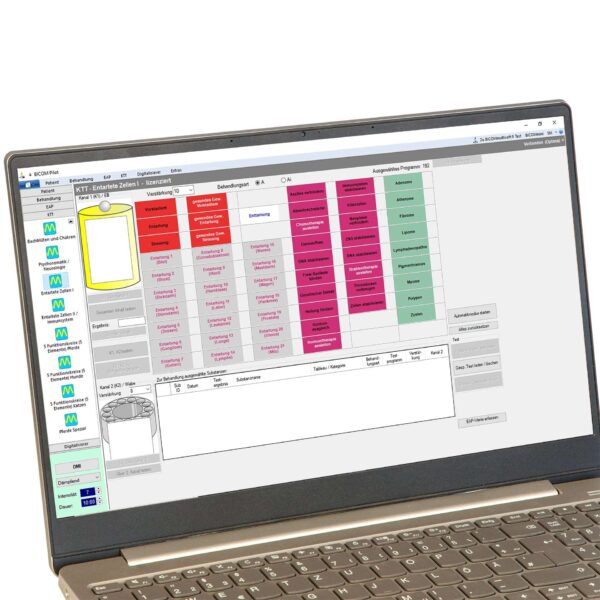
Digital Test Kits
More practitioner guidance is in our therapy tips.
Source: AKI (Akademie für Komplementär- und Informationsmedizin), “Making the invisible visible: Unmasking”, October 2026. This is practice guidance for trained BICOM users. It is not a diagnosis or a medical treatment, and no outcome is promised. Clients should keep working with their GP or vet and should not change any prescribed medication.